
Exhibition Insight... Golshad Asami: Rhythms of Home
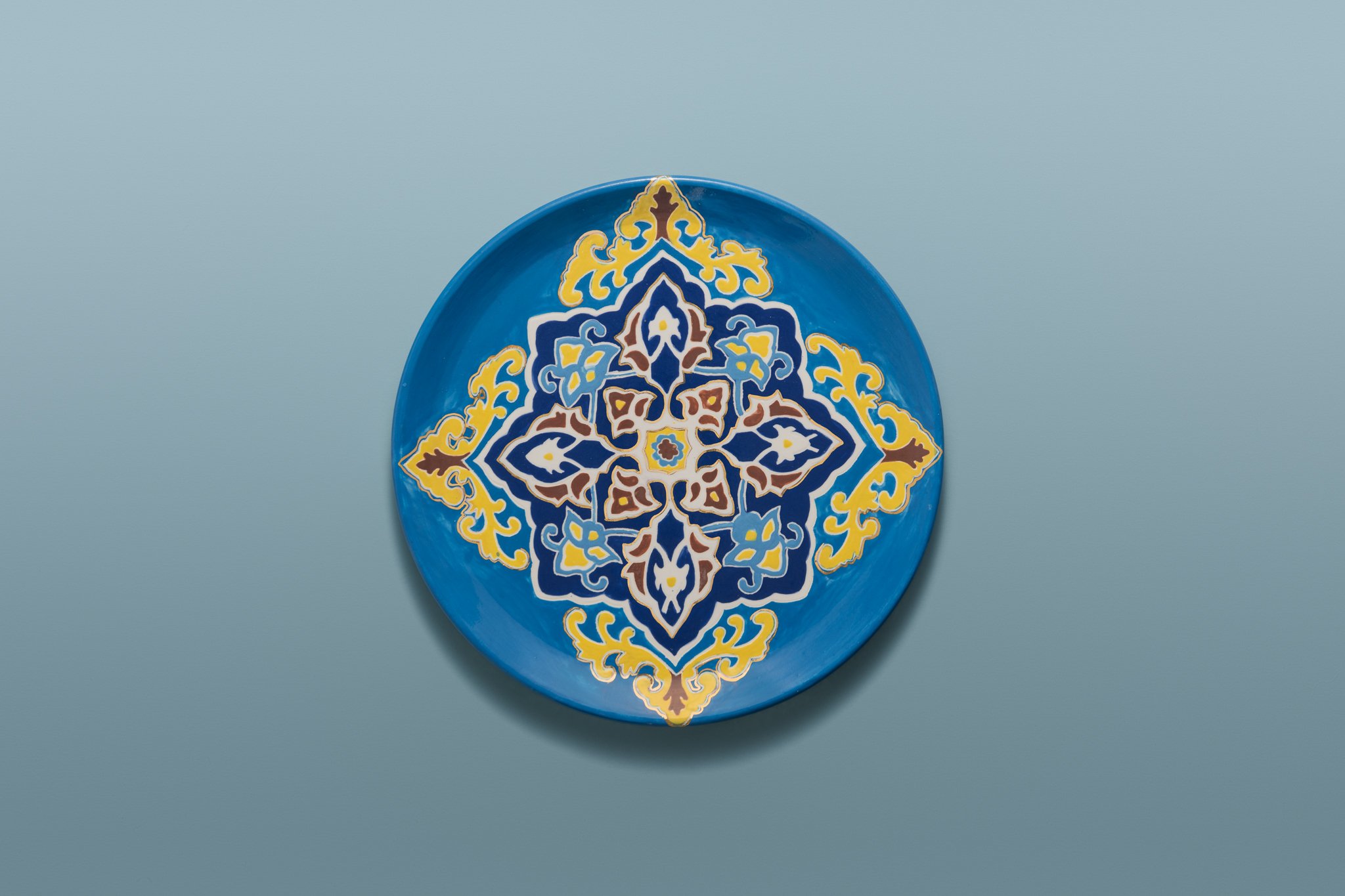
Golshad Asami:
Rhythms of Home
.هرچیز که در جستجوی آنی آنی
Whatever you are searching for , you already are.
Looking at the work of Golshad Asami in her new exhibition Rhythms of Home, I am drawn to the intricate detail and shimmering, dancing shapes. Ruby red flowers and golden accents play against the deepest blue of the sky, repeated refrains in a story about home and heart. The line of Golshad’s hand evident through her mark making, I am simultaneously aware of the lineage of traditional ceramics and the role of the maker in telling her own story.
Golshad, also called Goli, is an Iranian-Australian ceramic artist. Born in Iran, she has a masters in Materials Science Engineering (Ceramics), and began her career working in a tile factory and porcelain factory. In 2019 she moved to Australia and now works in JamFactory’s ceramic studio as Production Manager. This exhibition, Rhythms of Home, showcases Goli’s incredible technical skill alongside her talent as an artist, designer and calligrapher.
Symmetry and balance form part of the rhythm of this exhibition, creating an emotional language within the works. We see motifs inspired by Persian tilework intricately laid across the surface of the plates. Goli speaks about the elegance of Persian architecture, especially the star-like and floral motifs, which appear throughout this body of work. Her choice of colour and geometry references the quality of golden light that radiates from sacred domes and shrines. The work ‘Echo of Symmetry’ features the motif of Shamseh, an intricately decorated rosette or sunburst, symbolizing the infinite and transcendent nature of the divine. While in work ‘Bloom in Blue’ we see layers of tilework and illumination motifs; blossoms unfold like prayers.
Goli’s reverence and knowledge of the traditional qualities of Persian ceramics is evident in her approach to her practice. However, rather than replication, her reference to tradition is a way for her to speak about her relationship to home and culture. ‘I don’t aim to recreate tradition; I seek to reinterpret it to bring it into conversation with the present,’ she says. ‘By layering patterns, lines, and golden details, I explore the harmony that exists between structure and emotion, symmetry and freedom.’
Beauty is evoked through repetition and contrast, with some plates balancing richly decorated areas with ground dedicated to Farsi poetry. For most of us walking into the gallery, Goli’s calligraphy is a purely visual experience, we have the opportunity to explore the dance of Goli’s brush across the surface of the plate, the mark as an echo of the gesture. For Goli, the calligraphy is an act, a discipline and a creative flow. Control and intuition work together with the Persian script and the breath of the poetry.
‘Persian poetry has been a constant presence in my life,’ she says. ‘The verses of Hafez, Rumi, and Iraqi taught me that art is not only a way of seeing the world, but also a way of understanding ourselves. Their words, full of love, longing, and spiritual reflection, find their way into my work, sometimes directly, sometimes as quiet echoes. I often think of my plates as visual poems: each one tells a story, but in silence.’
In Goli’s work, we don’t just experience the surface decoration, but the medium of ceramic, the gesture of calligraphy and the nature of the glaze (applied viscous and transformed through firing). No one component holds hierarchy, and in fact the gallery in which the works are displayed also becomes part of the timbre of Goli’s story. In this space, the plates sit within the rich blue hues of the infinite sky.
Goli’s use of gold lustre within these works connects with a long-established history of luster in Persian pottery. Gold lustre first emerged in the early Islamic period, when artisans discovered how to create glowing, metallic surfaces through an intricate firing process. As the technique evolved and moved across regions, it eventually flourished in Iran, most notably in the workshops of Kashan, where lustreware became synonymous with mastery, light, and craft. The appeal of extends beyond the aesthetic, into the divine. The luminous, light catching quality of the lustre is sometimes associated with the concept of ajab or wonder. In Goli’s work, we can see this connection to the divine parallel the connection to history and place. Her work ‘Days of Love’ combines symmetry, poetry and accents of gold lustre to create perfect balance between poetic intuition, divine order and an exploration of belonging. ‘Nothing is sweeter than the days of love,’ she writes
خوش تر از دوران عشق ایام نيست.
Rhythms of Home is a meditative journey, taking time to acknowledge the beauty of who we are and where we have come from. For Goli, the work explores her identity, which like her works balance imperfection and spontaneity with symmetry and pattern. ‘Each of my plates holds a story’ she says, ‘of love, memory, identity, and the beauty of seeking meaning through art. I often return to a thought from Persian mysticism that everything we search for outside ourselves already lives within us. Through my work, I explore that quiet truth. I was born in ESFAHAN- IRAN, where art and life have always been intertwined, where poetry is spoken at the dinner table, where tiles, carpets, and calligraphy turn ordinary spaces into places of meaning.’