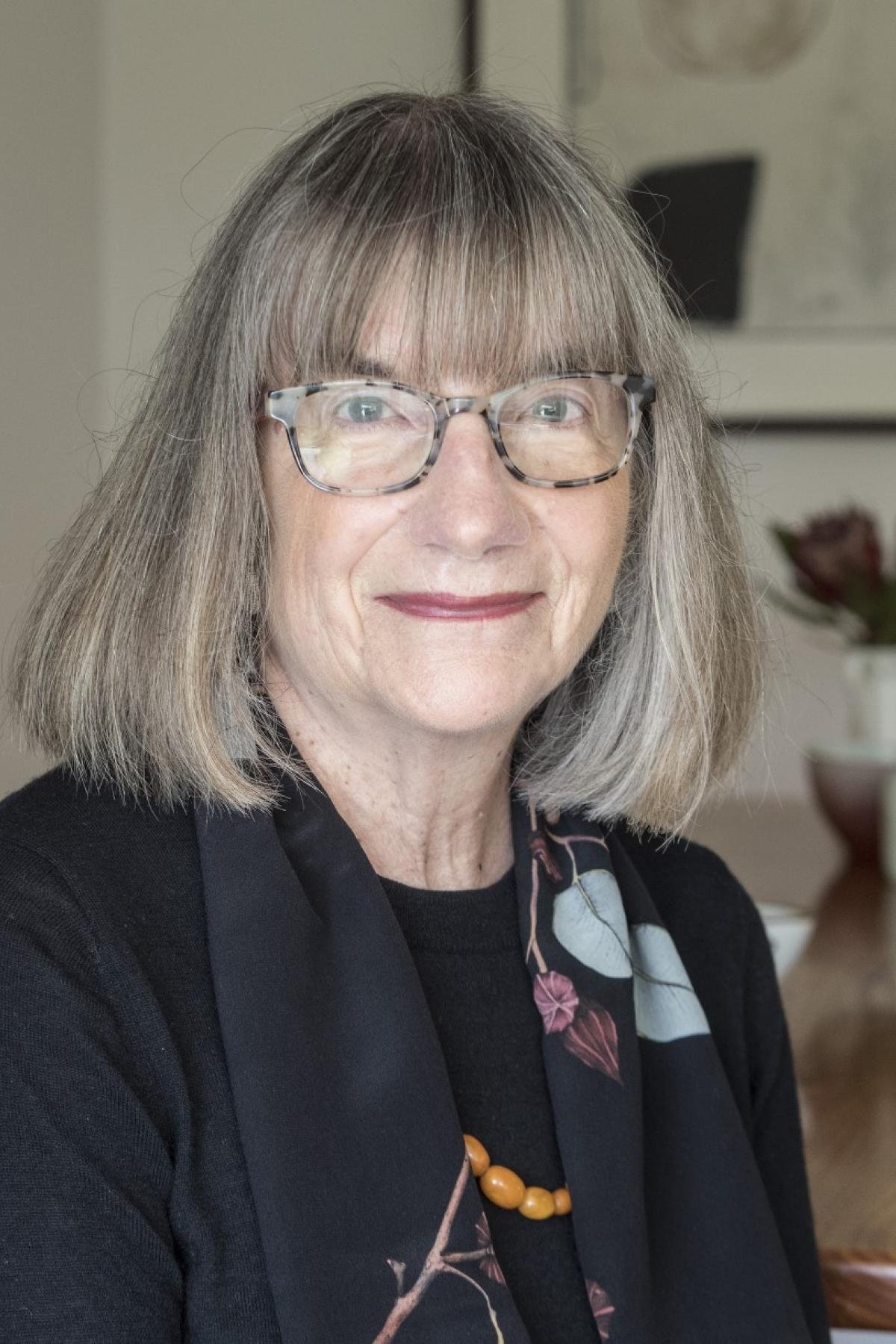
Lifetime Honouree... Margot Osborne
The Lifetime Honouree is awarded annually to an individual who has made an outstanding contribution to JamFactory and the wider craft and design community. It recognises the important role that administrators, curators, legislators and other non-makers play in creating a dynamic craft and design sector. The 2025 Lifetime Honouree is Margot Osborne.
As a curator, writer, and art historian, Dr Margot Osborne has made immeasurable contributions to the preservation and recognition of Australia’s creative community. She has written extensively on glass, ceramics, and the evolution of Australia’s contemporary arts scene, including Australian Glass Today (2005) and The Adelaide Art Scene: Becoming Contemporary 1939-2000 (2023). Following training in London and New York, she was JamFactory’s Gallery Curator from 1998 - 2001 and was the co-curator for JamFactory’s 40th anniversary show in 2013. She has continued to work closely with JamFactory and other arts organisations on essays, catalogues, and exhibitions across multiple mediums, including monographs for JamFactory ICONS Nick Mount and Giles Bettison and previous Head of JamFactory’s Ceramics Studio Jeff Mincham (1979-83). Many of the projects she has worked on have travelled overseas, including Art from South Australia to Japan and Ten Australian Jewellers to Indonesia, helping to expand the horizons of many local artists and designers. Her expertise has lent itself to her role as a judging panel member for the FUSE Glass Prize and Ranamok Glass Prize, amongst others.
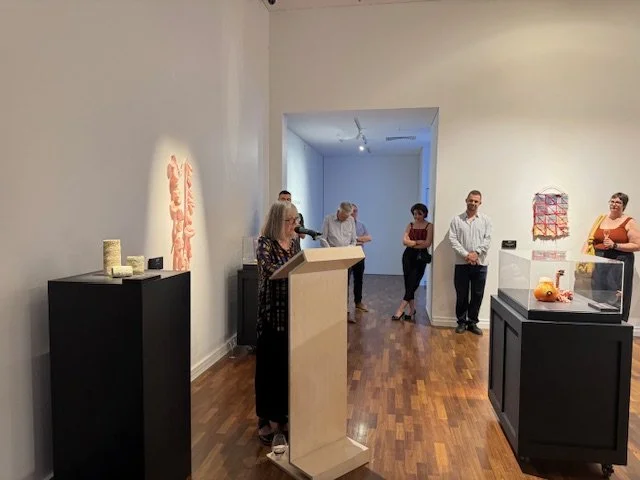
Discover Margot’s speech from JamFactory’s Lifetime Honouree event held on
Thursday 4 Decemebr 2025:
Thank you, Brian, for your support of my career, going back to your time at Object, and especially since you have been CEO of JamFactory. Thank you, John for your friendship and moral support across more than fifty years.
I would like to say a few words about why craft practice in general, and JamFactory in particular, have been so important to me across my career, and by extension why I think they are important to all of us.
It all started back in 1974 when I joined the newly established Crafts Board of the Australia Council as a graduate clerk. What attracted me to the crafts then was collective energy of the crafts movement, the valuing of skill and beauty as intrinsic to the crafted object - in comparison to the strident rejection of beauty and skill in avant garde art of that time.
A pivotal moment for my creative development was my time as a trainee at the Museum of Contemporary Crafts New York from 1975-76. This was a first experience of working as part of a curatorial and exhibitions team to organise and install exhibitions. I was instantly hooked and from then on saw my career as being in creative project and exhibitions development.
I came back to Australia in 1976 and became a consultant exhibitions manager for the Crafts Board – managing 10 Australian Jewellers Indonesian tour and Australian Crafts state gallery tour. After that, in the intervening 20-year period before I became exhibitions curator at JamFactory I consolidated my experience across a wide field - as a curator, gallery director, arts administrator, program manager and art critic.
At JamFactory as exhibitions curator from 1998-2001 I was once again working with contemporary craft, and just as had been the case in the early to mid 1970s, it was an exciting moment for South Australia in the crafts. In jewellery there was Gray Street Workshop; in ceramics there was Stephen Bowers, Gerry Wedd, Robin Best and the fledgling Ernabella ceramics group; and especially in the field of glass, there was the emergence of a whole generation of glass artists, who would go on to establish national and international reputations - Nick Mount, Giles Bettison, Jessica Loughlin, Clare Belfrage, Deb Jones, Tom Moore and Gabriella Bisetto.
To some extent I rode the wave of that collective creative energy that emanated from the studios at JamFactory and from the wider field of affiliated craftspeople.
Amongst those who had exhibitions during my time at JamFactory there were solo exhibitions in Gallery One by Gerry Wedd, Khai Liew and Peter Walker; and in Gallery 2 a first solo by Vipoo Srivilisasa, and exhibitions by Sue Lorraine, Leslie Matthews, Adrian Potter, and Robin Best.
I am particularly proud to have invited Frank Bauer to hold a survey exhibition, which travelled to the Powerhouse Museum.
Between 2000 and 2010 I curated several important exhibitions for JamFactory, both while I was on staff and then as a consultant curator, namely: The Return of Beauty, which toured to Object, Sydney; Permutations: Five Australian Glass Artists, which was shown in Seattle; Wild Nature in Contemporary Australian Art and Craft which toured nationally from 2002-5 through the Visions of Australia program; and in 2010 the glass exhibition Mind and Matter which was presented at JamFactory and Object. Then in 2014, I collaborated with Brian Parkes and Margaret Hancock Davis as co-curator of the 50th anniversary touring exhibition Designing Craft/Crafting Design.
My curatorial sequel to Wild Nature was the substantial exhibition Abstract Nature, at The Samstag Museum of Art in 2010, occupying the entire two floors and comprising works by 20 artists, including seven closely associated with the expanded JamFactory community – namely Robin Best, Giles Bettison, Julie Blyfield, Jessica Loughlin, Leslie Matthews, Catherine Truman and Angela Valamanesh.
Across these exhibitions I progressively developed and refined a coherent curatorial rationale. Key to this rationale were values that had influenced my practice from my first encounters with contemporary craft – namely, appreciation of the inter-relationship between skill and beauty and the natural environment. Also, in this mix from the late1980s was my interest in the cross-fertilisation between Indigenous and non-Indigenous art. The Return of Beauty, Wild Nature and Abstract Nature exhibitions included significant representation of Indigenous artists.
The following excerpt from my essay for Abstract Nature encapsulates the essence of my aesthetic philosophy at that time:
Embodiment – the synthesis of sensibility, skill and material form – is at the heart of beauty. The artists in Abstract Nature share an approach to making art that is based on the long practice of gradually acquired skills, fused with a sense of the interpenetration of material and immaterial dimensions of art.
The other aspect of my practice that intersects with JamFactory has been writing, editing and publishing. My first commission was for the SALA monograph on Nick Mount in 2003. This was followed by the self-initiated publishing venture, Australian Glass Today, featuring 45 glass artists, including 14 South Australians. This sold throughout Australia and USA and played a role in raising the profile of Australian contemporary glass. In 2010 I undertook a commission from Object for a book on ceramicist Jeff Mincham as part of their Living Treasures series to accompany the national touring exhibition. Then in 2014 there was a SALA commission for glass artist Giles Bettison, and, finally, a crowd-funded book to posthumously celebrate ceramicist Liz Williams. All but the Jeff Mincham monograph were published by Wakefield Press and were funded in part either directly or indirectly by Arts South Australia.
At the same time, I had returned to university to complete a masters degree and then a PhD in art history. I followed this with my seven-year research and writing project which culminated in the publication two years ago of my landmark history, The Adelaide Art Scene: Becoming contemporary 1939-2000. In this book one of the sub-themes was that the history of craft practice in Adelaide was essentially a contrapuntal influence, in creative tension with the wider movements of contemporary art.
For the past 15 years, under the leadership of Brian Parkes, JamFactory has successfully evolved, survived and thrived in response to the pressing challenges of the artistic, educational, economic, technological and political climate. The existential threats he has averted are nowhere more apparent than in the recent shock announcement of the defunding and hence forced closure of the Australian Design Centre, in Sydney, presenter of the impressive Make Award exhibition to be opened in the gallery tonight.
As the gallery has always been my area of special interest, I am absolutely delighted that JamFactory has appointed a curatorial director, Dr Lee-Anne Hall, whose position will have an equivalent status to the studio creative directors. It is a long overdue upgrade that responds to the creative and managerial responsibilities of the role.
In conclusion, what has always been special about JamFactory has been its mix of studio-based craft practice, gallery exhibitions and retail. There is a synergy to this mix, a balance between the individual and collective, between creative experimentation and the pragmatic imperatives of design. Looking from the outside, as a non-practitioner, it is my impression that the discipline of working as part of a team engenders a level of mutual co-operation that continues amongst alumni well past their time at JamFactory. No doubt there are plenty of rivalries, frustrations and frictions too, but I am convinced that this collective, supportive approach has been deeply embedded in the formative DNA of JamFactory and has spread in ripples throughout the wider crafts scene here, to contribute to making Adelaide, arguably, the beating heart of craft and design practice in Australia.
Thank you JamFactory for this award. I am thrilled and very proud to have my career recognised in this special way.