
Exhibition Insight... Heart of Darkness

Belinda Guerin, 2025, Thorn Spell Box; Crimson Stacked Apothecary Box; Rose Spell Box, reduction fired stoneware, Photo: Connor Patterson
Heart of Darkness is a visually rich showcase of contemporary craft objects that appeal to Gothic sensibilities and feature symbols, motifs and aesthetic cues that draw on our innermost fears and dark desires. As a literary, artistic and aesthetic style, the Gothic has long been employed as a means to explore and express the darker aspects of life that are usually unsettling, unspoken, or hidden from view. Rather than avoiding the uncomfortable, the Gothic aesthetic draws it to the surface through heightened drama, symbolic imagery, and emotional intensity. Dark shadows, decaying textures, obscure silhouettes and frightening motifs act as visual anchors that make our internal experiences tangible. In illuminating our fears and anxieties and giving shape to darkness, the Gothic thereby transforms them into something that we can see, feel, contemplate and navigate.
The Gothic gives artists permission to explore unsettling subjects such as death, decay, melancholy, the occult and the supernatural, framing them not as horrors to flee, but as profound aspects of the human condition. Through symbolism and sensory richness, the Gothic turns fear into fascination and transforms private anxieties into shared, aesthetic experiences, offering a safe space to confront that which might otherwise remain supressed. By doing so, it reframes darkness as a generative force: one that inspires Introspection, sparks imagination and invites deeper engagement with the mysteries that lie at the edges of everyday life. In this way, the works presented in Heart of Darkness form a collective narrative that honours the Gothic tradition while reimagining it through contemporary artistic voices - proving that darkness can be a path to illumination, knowledge, discovery and creativity.
Heart of Darkness features fourteen artists working across ceramics, jewellery, glass, fibres and multimedia whose works incorporate symbols, motifs, colour palettes and sensibilities that are associated with the Gothic. These artworks – beautiful, mysterious and tinged with the macabre – invite audiences to step into the shadows and experience the allure of that which dwells in darkness.
Darkness isn’t absence – it’s where the soul thrives.
WORDS BY CAITLIN EYRE

Welfe Bowyer, Sprue Rings, Photo: Connor Patterson
Welfe Bowyer is contemporary jeweller and artist born in Cymru/Wales and who is currently based in Aotearoa/New Zealand. While working in the architectural field, Welfe began experimenting with jewellery design, which allowed him the perfect medium with which to conceptualise, experiment and create three dimensional forms on a scale different to that of architecture. Predominantly self-taught, in combination with skills courses at Melbourne Polytechnic, Welfe’s jewellery has its emphasis on form and structure, material combinations, and textures that are used to bind elements.
In his jewellery practice, Welfe creates hand-made textures with common alloys of Bronze, Silver and Gold and combines them in unique ways. He often uses found objects and playing off the strengths of one material over another to create a language that speaks of time, erosion, memory and how pieces might evolve in the future as they are worn. For this collection, Welfe utilises offcut spruces often discarded from the casting process and arranges them in tall, forest-like clusters, offering glimpses of colour scattered and embraced throughout the darkness.

Emma Davies, Tree Totems, Photo: Connor Patterson
Emma Davies (VIC) is a Naarm/Melbourne-based artist with an established reputation for innovative and creative installations for both the public and private commercial sector. In her practice, Emma juxtaposes her interest in bio-mimicry with the use of non-traditional materials such as polypropylene packaging, twines and recycled plastics. Using a process of discovery and invention that is largely experimental, Emma satisfies her curiosity by working with contemporary materials and using unconventional methods to challenge the possibilities of each creation. Her reward is in removing materials from common functionality and being able to transform what is intrinsically ugly into something beautiful.
In Sentinels, Emma captures the desert in a moment of transformation. Following floodwaters down the ancient path of Cooper Creek into Lake Eyre, she records the haunting beauty of partially submerged Coolabah trees. Filmed at sunset, the landscape becomes a mirror of itself – water and sky collapsing into one. The video slips into abstraction, evoking Rorshach inkblots, desert totems, ghostly spirits and even erotic forms. Faces, bodies and hybrid shapes emerge and dissolve, inviting contemplation of the shifting line between and is seen and what is felt.
Sentinels is not a stand-alone work, but a reference point for Emma’s concurrent bone sculptures. Drawing on the creek’s rhythms and visual motifs, she shapes imagined remnants of life – forms recalling vertebrae, ribs and fossilised fragments. These sculptures carry the desert’s dry, skeletal language, evoking the fragile persistence of life and memory within an arid, timeless landscape.

Belinda Guerin, Serpentine Altar, Photo: Connor Patterson
Belinda Guerin (SA) is a Tarntanya/Adelaide-based artist who uses her ceramics practice, faebel, to explore visual storytelling through illustration and form. Inspired by the embedded myth and folklore of ancient ceramics, faebel investigates the role of the maker to pass on stories by creating objects which embed themselves in the rituals of everyday life. Her practice seeks to retell and create its own folklore, highlighting the importance of human creation throughout history.
For this new body of work, Belinda was inspired by the occult legend of the witch and explored the fantasies which have both threatened and empowered women throughout history. Each piece in this series reflects upon the magic rituals which have brought the non-confirming together, creating tightly knit circles of wonder and unity. Reminiscing on ceramics as an ancient craft, Belinda centres herself by connecting to the land she works on – sculpting with clay dug from Australian soil and selecting locally hand-dipped candles.
Taking time and care, Belinda has adorned each artwork with delicate detailing which invite a coven to gather:
Open the box. Light the candle. Look into the mirror.
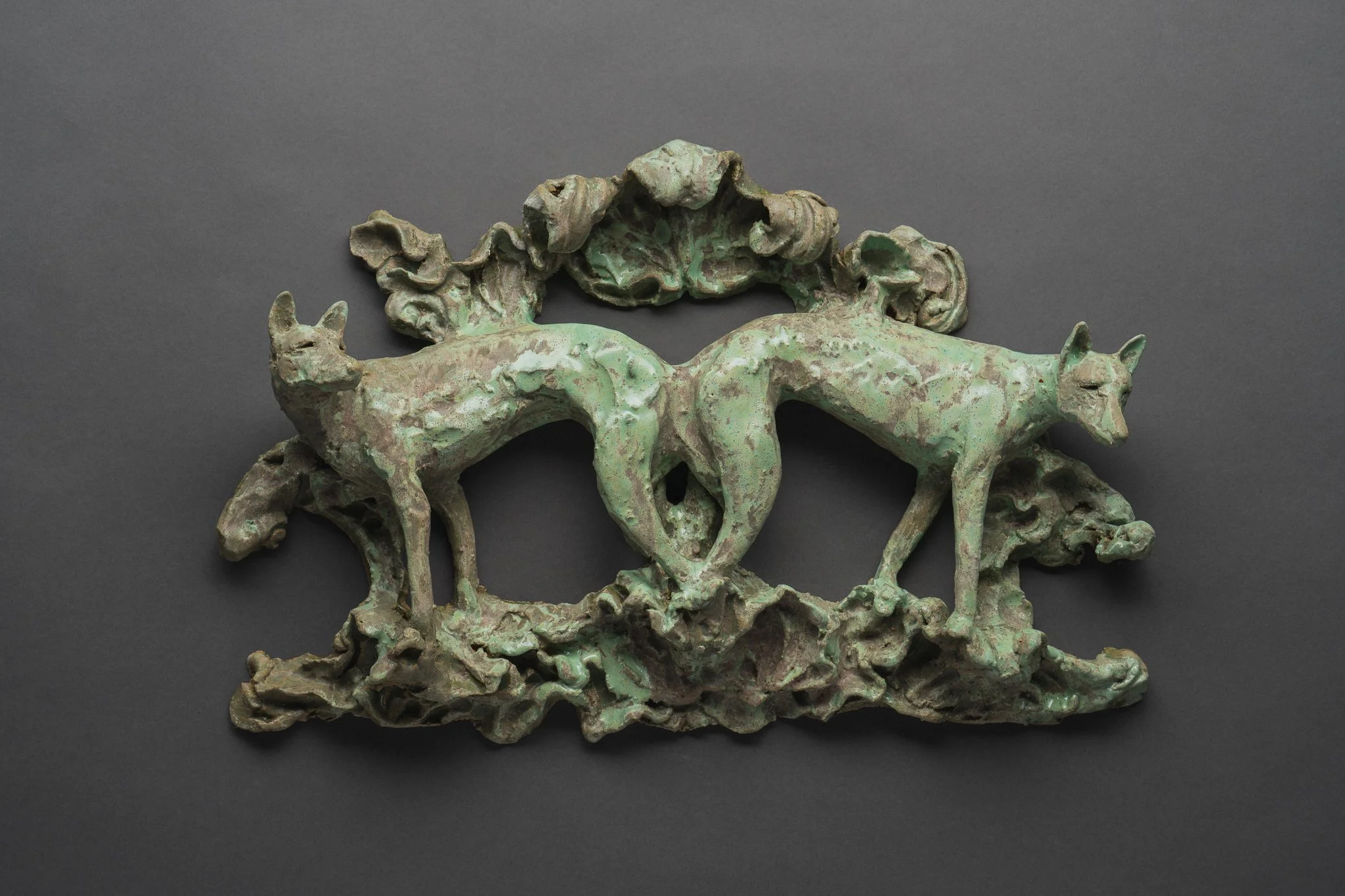
Harriet Geater-Johnson, Dingo Elegy, Photo: Connor Patterson
Harriet Geater-Johnson (SA) is a ceramic artist who currently resides in Port Elliot on South Australia’s Fleurieu Peninsula. Hailing from the United Kingdom, Harriet’s nomadic existence has seen her live in five Australian states over the past thirteen years. Through her work, Harriet is interested in exploring the conflict and cohesion between humans and animals, with consideration of how their presence causes a continual impact to the natural environment.
In this new body of works, Harriet explores the complex relationship between humans and native Australian animals in the wake of colonisation. These handbuilt ceramic works reimagine Victorian-era forms such as funerary urns, memorial wall reliefs and domestic vessels by merging colonial decorative aesthetics with symbols of environmental loss. The ornate surfaces and antique forms evoke the grandeur of Victoriana, while their subjects – native fauna entwined with motifs of memorandum – allude to the consequences of European settlement and subsequent impact on ecological symptoms. Ceramic bones, recalling rabbit remains, are shaped into a British jug, symbolising the infiltration of introduced species and cultural dominance. Together, these works act as contemporary relics.

Ebony Russell, Frown Face Series, Photo: Connor Patterson
Ebony Russell (NSW) is a Sydney-based artist whose unorthodox ceramics practice challenges traditions of craft, gender and decoration. Developing a unique technique of piping porcelain into intricate layers, she creates gravity-defying forms where ornamentation becomes structure, erasing the boundaries between vessel and embellishment. Her work interrogates cultural and artistic practices once dismissed as feminine or insignificant, instead celebrating excess, pleasure, and the politics of decoration.
A short book written in 1956 on Women in Antiquity inspired Ebony to begin creating forms mimicking Greek and Roman vessels. Traditionally these forms are richly illustrated with women celebrated in daily roles, rituals and myths. Mortal or immortal, womenkind was a more independent and influential figure in these pre-history times. Ebony’s unorthodox ceramic piping technique was developed out of an interest in gendered aesthetics and labour. Craft, ceramics and fancywork collide with gold lustre framing my sentiments referencing wealth, social status and the classically feminine interior.
A decade after the #metoo movement and Ebony’s personal disappointments in recent events from criticism of Grace Tame withholding a smile to the American reversal of Roe v. Wade are evident in these works. Women do not owe you a smile and neither do Ebony’s urns.
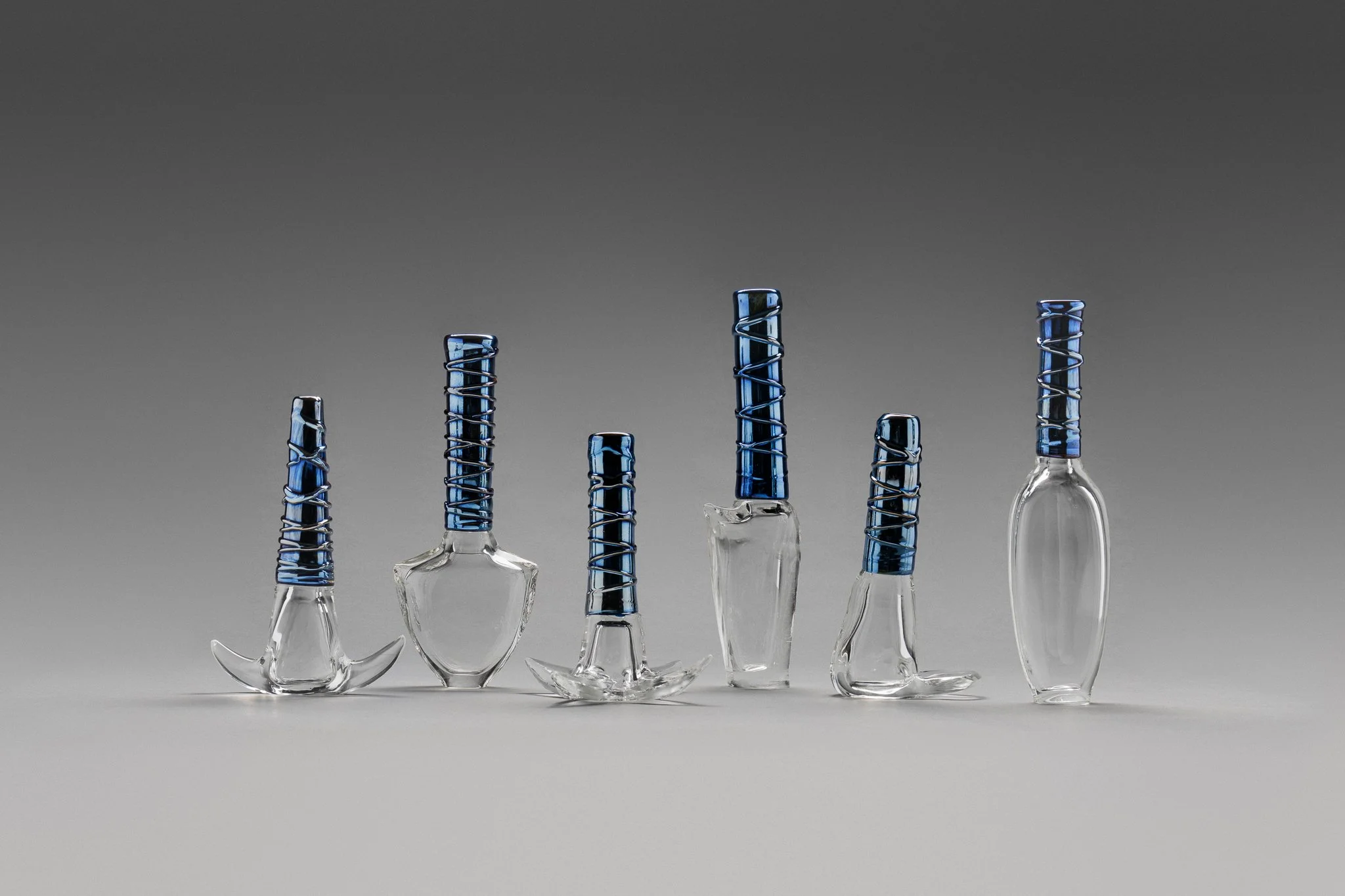
Alex Valero, Hoard Vessels, Photo: Connor Patterson
Alex Valero (SA) is a glass artist based in Tarntanya/Adelaide known for his innovative and experimental approach to working in hot glass. In the creation of his artworks, Alex often draws on philosophy, science and science fiction. Alex’s glass objects express a desire to grapple with ‘deep time’ — a way to imaginatively explore the span of history, from forgotten pasts to speculative futures. Mixing elements of archaeology with markers of science fiction, Alex’s work aims to provide unstable ground from which an audience can extend their perspective and deeply consider the vastness of human experience. Invoking collections of grave goods, votive deposits and hoards, the work Hoards suggests a thread to guide such explorations: our desire to make and accumulate stuff, and through them, shape our environment in a way that lasts beyond our lifespan.
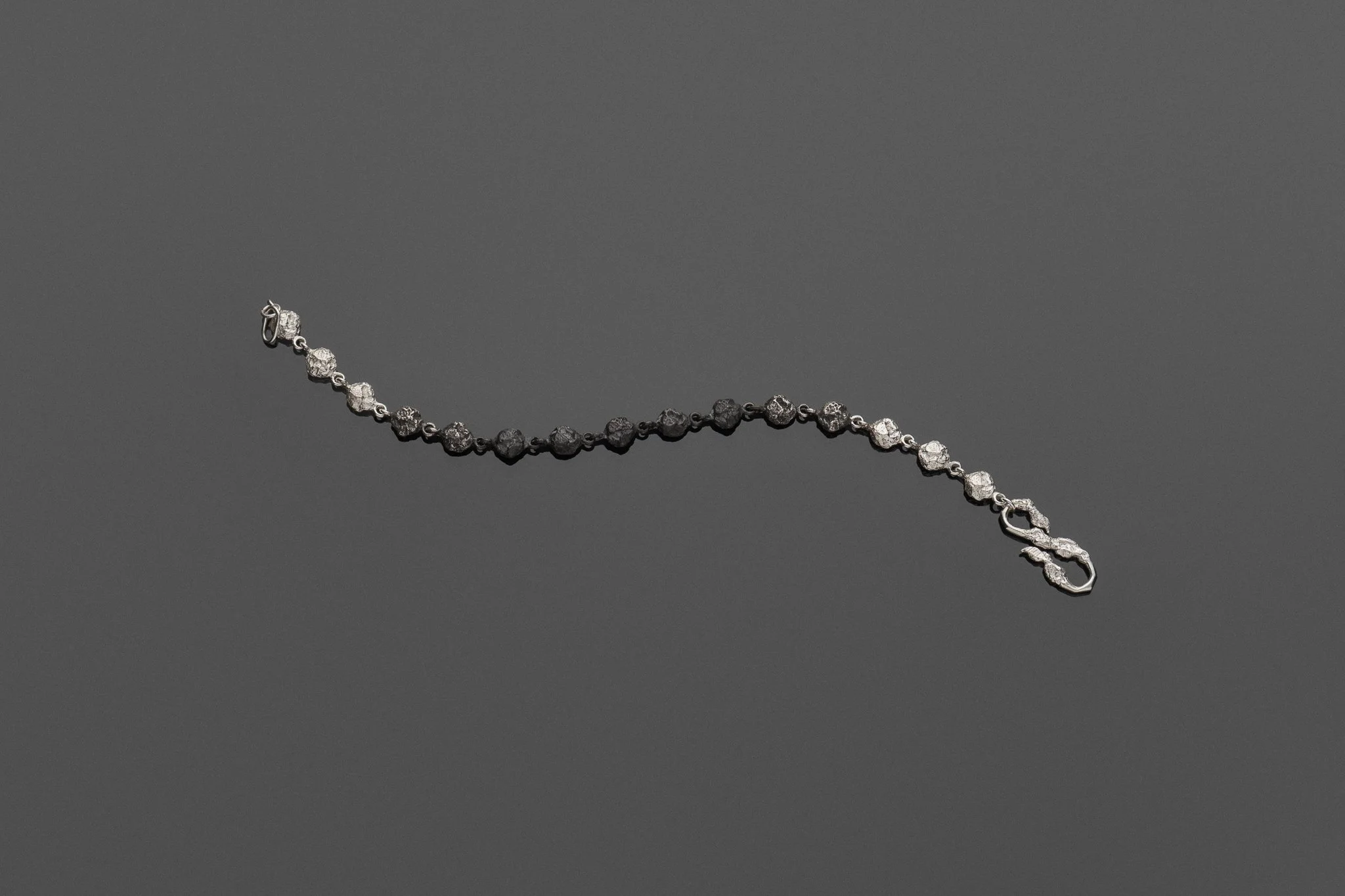
Alicia Hannah Naomi, Moraine Bracelet, Photo: Connor Patterson
Alicia Hannah Naomi (VIC) is a Naarm/Melbourne based contemporary jeweller whose work interrogates impermanence, erosion, and transformation. Informed by Australian landscapes and environmental change, her sculptural forms evoke a meditation on decay and resilience. Her jewellery embraces irregularity, with geological surfaces appearing hewn from the earth. Contrasting polished planes and faceted gemstones reflect the tension between the passage of time and human intervention. Through her practice, she crafts wearable artefacts that contemplate materiality and fragility.

Drew Spangenberg, Old Gold Venetian Goblets, Photo: Connor Patterson
Drew Spangenberg (SA) is a contemporary glass artist based in Tarntanya/Adelaide. In his practice, Drew combines traditional glassblowing techniques with a refined contemporary aesthetic, defined by clean lines, harmonious forms, and a considered approach to colour and composition.
The Old Gold Venetian works draw on the techniques and visual language of traditional Venetian glassblowing. While developing concepts for this exhibition, Drew was inspired by the old world charm associated with Venetian craftsmanship. Drew’s aim is to both challenge his technical ability and to help preserve a meaningful artistic legacy.

Regine Schwarzer, Spoons, Photo: Connor Patterson
Regine Schwarzer (SA) is a contemporary jeweller who works from her custom-built studio located in the Fleurieu Peninsula on the lands of the Kaurna and Ngarrindjeri Peoples. Born in Germany, Regine grew up in Bavaria and trained in jewellery-making and metalwork at the Zeichenakademie Hanau, one of the oldest training institutions in Europe. Her move to Australia in 1993 profoundly influenced her work as she discovered a passion for rocks and minerals which occur in abundance here. Inspired by the colours and structures of these minerals, Regine learned how to shape them and uses them often in her work.
In Heart of Darkness, Regine explores the Gothic aesthetic through a material dialogue between the natural and the symbolic. Drawing from a collection of gems and meticulously sourced minerals, her works employ a restrained colour palette, oxidised metal, and refined highlights of polished metal and coloured gems. Across the objects, Gothic motifs are reinterpreted to evoke the mystical, the cyclical nature of life and death, and the transformation of the everyday into the precious. Themes of decay, renewal, and transcendence emerge through recurring forms such as seed pods and containers, inviting contemplation of mortality and regeneration. Each piece encourages the viewer to consider how material and symbolism converge within the poetics of human imagination.

Emma Shepherd, Sanctum, Photo: Connor Patterson
Emma Shepherd (VIC) is a weaver who practices one of the world’s oldest crafts with the sensibility of an artist deeply embedded in her environment. Thinking through fabric, its strength and its structure, Emma has acquired an innate understanding of textiles as a universal language, as well as the long history of weaving as a centre for innovation, intuition and intimacy. The Bauhaus ethos remains central to
Shepherd’s practice where art, craft and design are seamlessly integrated without hierarchy. Carefully selected yarn affords Emma the opportunity to reflect on the deeper lineage of fibre, allowing each material – especially those collected from sites around her Flinders studio – to shape the work in a gentle yet deliberate way. Horsehair, bark, pine needles and waste materials like banana fibre are all incorporated. She honours the landscape where she lives and works by periodically folding in colours resembling the verdant foliage, dark tones of tree trunks, and the neutrals of the sand and stone of her coastal hometown.
For this exhibition, Emma created works that explore the depth and complexity of black, its mystery and material presence. Long associated with mourning, power and mythology, black is at once feared and revered. Black is not simply an absence: it can absorb, conceal, and carry lightness when woven with an open structure. The banana fibre has been dyed with eucalyptus and iron, not a true black, but with tonal variation. The works reconsider black as a living colour, one that can be both weighty and ethereal, grounded and porous. Through texture, contrast, and pattern, the works test how darkness can hold movement and energy.
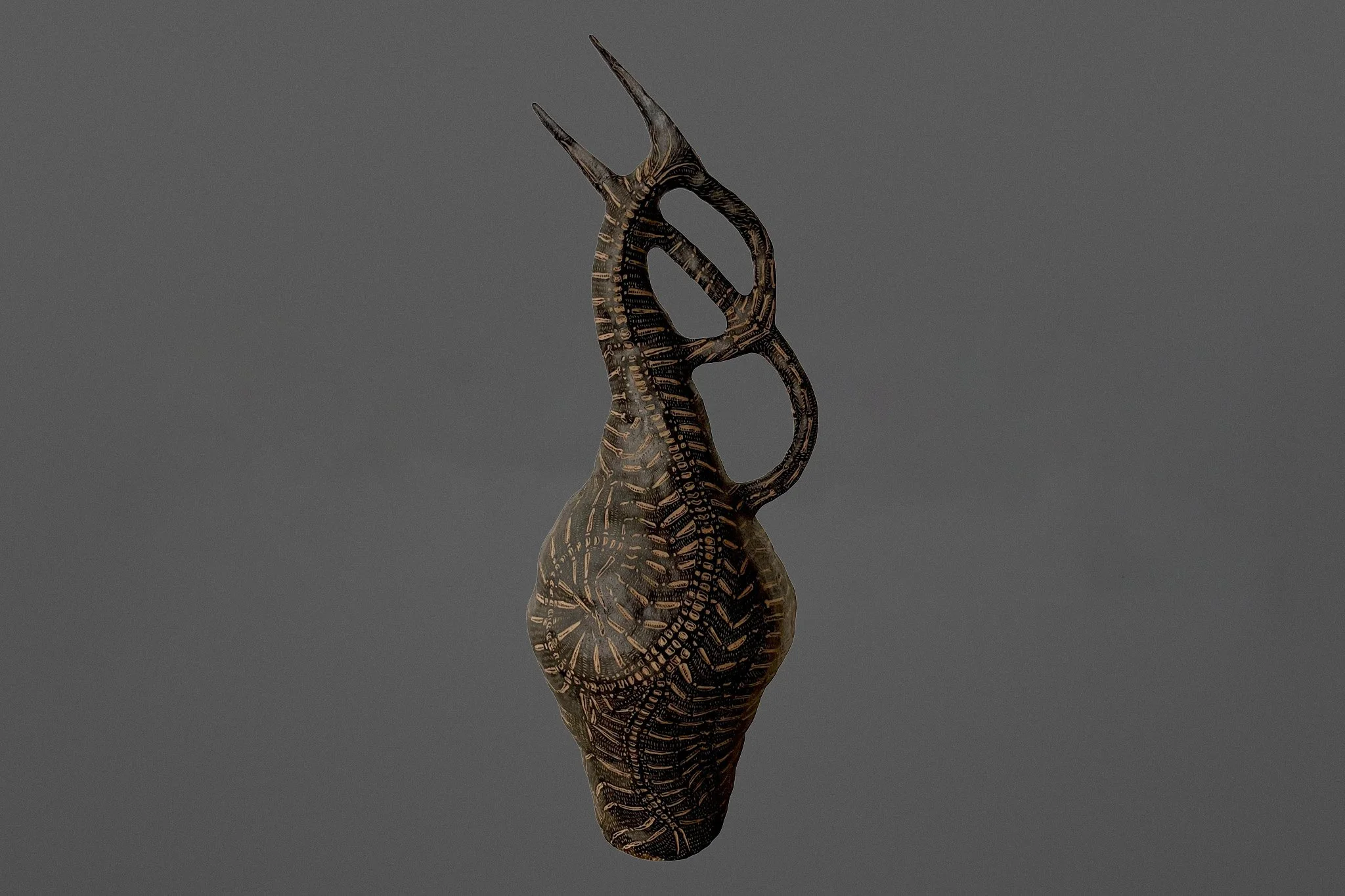
Karlien van Rooyen, Loveliness of the Catacombs
Karlien van Rooyen is a South African ceramic sculptor whose conceptual practice is deeply informed by an unconventional life shaped by science, activism and personal transformation. Her work, rooted in the materiality of clay, explores themes of resilience, trauma and transformation, often drawing inspiration from wild landscapes and the tension between fragility and strength. Through sculpture, Karlien continues to navigate the complexities of the human condition and its entanglement with the natural world.
This series of ceramic works explores the paradoxical spiritual state of Charmolypê, a key concept in Eastern Orthodox Christianity signifying the simultaneous experience of joy and grief. Karlien was very close to her grandfather, a pastor in South Africa, and chose to lean heavily into her Christian roots to process a massive series of family tragedies to help her navigate her grief. Drawing from her own lived experience of profound personal loss and four years spent in rural Australia, Karlien’s work manifests the coinciding reverent brutality and beauty she found in nature. Borrowing from the gothic beauty of the Catholic tradition, the sculptural surfaces mimic the desiccated textures of salt-crusted mud, brittle thorns, melted metal, and patinated stone to reflect the raw, existential landscape of bereavement.
Through this work, Karlien aims to articulate the paradox of Charmolypê, framing personal suffering as a means to achieve an embodied proximity to the agony and ecstasy inherent in the Passion of Christ. By embracing the penitential austerity of the Lenten season, these sculptural forms celebrate the embodied enlightenment that arises from enduring sorrow or a dark night of the soul, seeing this experience as a profound contemplation of redemptive suffering and ultimate joy.

Julie Winn, Midnight Garden Wall Work Large, Photo: Connor Patterson
Julie Winn (SA) is a ceramic artist based in the Barossa region of South Australia. Working primarily in porcelain, she creates delicate floral wall pieces and sculptural forms that explore themes of resilience, fragility, and transformation. Her work has been exhibited nationally, recognised in major art prizes including the Waterhouse Natural Science Art Prize, the Biennial North Queensland Ceramic Awards, and the Stanthorpe Art Prize. Julie continues to extend her practice through professional development, most recently completing an intensive 2025 workshop with international artist Judit Varga at Gaya Ceramics in Bali.
This series examines the interplay between strength and fragility using Keane’s black clay and black-grey cement. The works reference the emergence of beauty from shadow, where darkness becomes a space for quiet resilience. Each piece reflects a balance between permanence and delicacy, inviting contemplation on endurance, renewal, and the contrasts inherent in the natural world. The work considers how materials and form can embody both vulnerability and resolve.

Claybia Ceramics, Arachnobutt, Photo: Connor Patterson
Claybia Ceramics (VIC) is a Naarm/Melbourne-based ceramic collaboration between Cassandra Chilton and Molly O’Shaughnessy, who are both members of the Hotham Street Ladies art collective. Working under the motto ‘Dark Ceramics for Dark Times’, Claybia’s practice is centred around non-traditional sculpture, exploring the darker sides of art and life, humour, feminism, the everyday, the misshapen, the peculiar, and drawing on our shared sinister ceramic history.
Elegy for Empty Vessels
As the mournful wind howled through the bare remnants of Morphett Street, razing the lands with its touch, only a group of solemn relics remained standing against the dark sky. Cloaked in mist, remnants of clay and the Bay of Biscay’s damp, blackened soil clinging to their sides, they rise ghostlike in the moonlight, stood upon a mound of detritus.
When examined, the group reveals itself to be not rubble, but an array of ghostly remnants: stubs of cigarettes, fractured oyster shells bleached pale by time, hollowed bones of long-dead beasts, and a grim menagerie of gothic birds, clawing their way from the rocks and earth as if summoned. Weathered by the ceaseless winds of time and draped in the slumber of sediment, this ancient group stands untouched, holding secrets that whisper to the dusk.