
FUSE Glass Prize: Finalists Announced
JamFactory is thrilled to announce eighteen finalists have been selected for the FUSE Glass Prize 2026.
The judges reviewed high quality and diverse entries from across Australia and New Zealand. The winner of the FUSE Glass Prize Established Artist Category will receive a $20,000 non-acquisitive cash prize, with the winner of the David Henshall Emerging Artist Prize receiving a $5,000 cash prize plus a professional development opportunity at JamFactory valued at $5,000.
The exhibition of finalist’s works will be shown at JamFactory from 24 April - 5 July 2026 followed by the ANU School of Art & Design Gallery from 18 August – 4 September 2026
The winners of the Established and Emerging Categories will be announced on 25 June 2026.
Emerging Artist Finalists
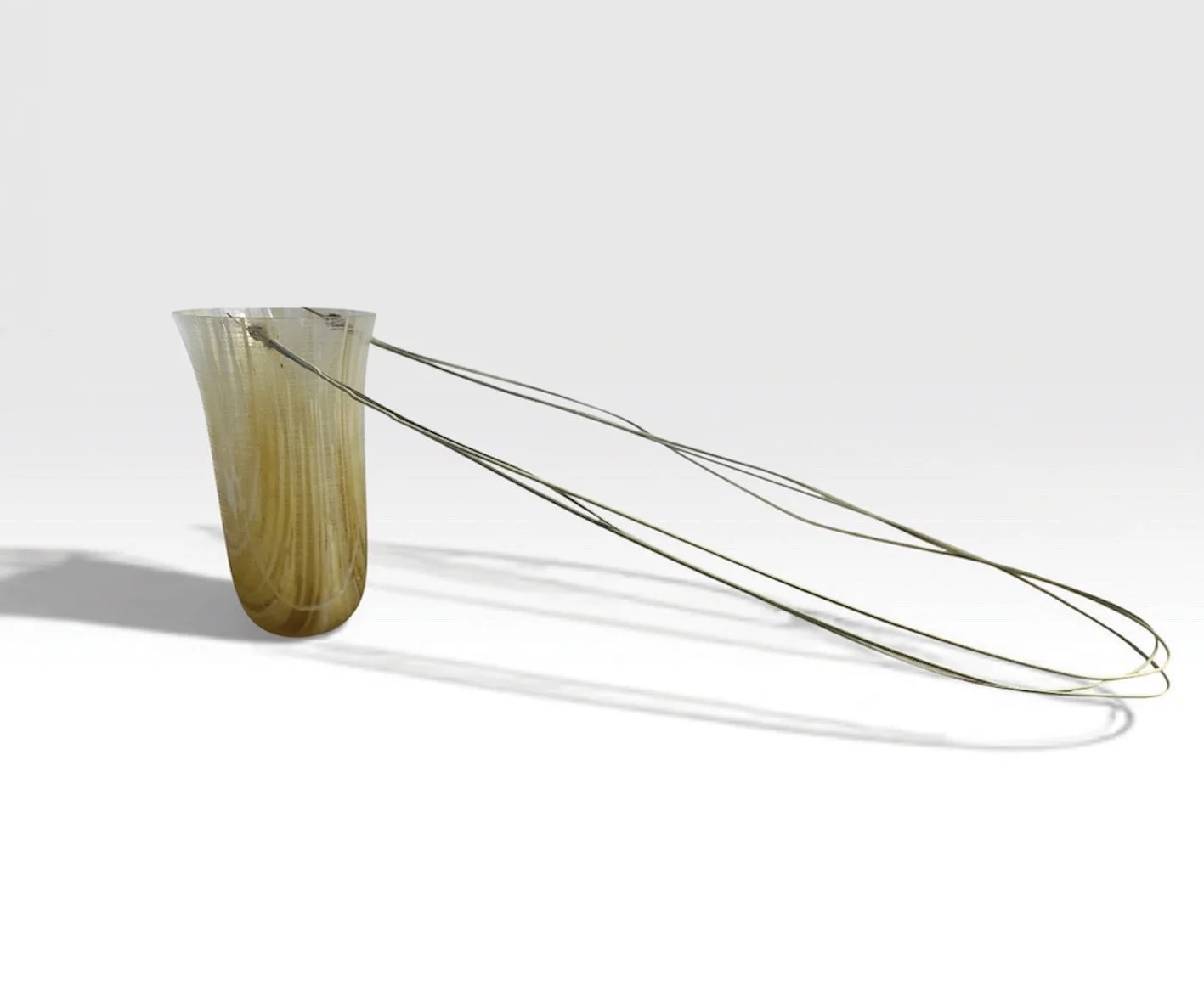
Photo: the artist
Racquel Austin-Abdullah (VIC)
Pirlu-Pirlu (Dillybag), 2026
Kiln formed and engraved glass, rush (consolidated)
169 x 480 x 86mm (Installation)
This work reinterprets the dillybag through kiln formed glass, paired with rush handles creating a quiet tension between fragility and endurance which grounds the vessel in plant knowledge and the river ecology of the Ba:Ka (Darling River). My current training in cultural materials conservation shapes how I approach Pirlu-Pirlu, applying reversible materials and techniques in order to strengthen fibre preventing it from breaking down. In my work I consider how objects endure, how they are stored, handled and carried across time.
Racquel Austin-Abdullah trained in Visual Arts in conceptual Jewellery (North Adelaide School of Art), hot and kiln forming studio glass (South Australian School Of Art, University Of South Australia) and most recently in kiln forming and innovative glass (Melbourne Polytechnic ). As an emerging studio kiln artist and owner of Glass Eel Creative, Austin-Abdullah is interested in cultural material as a product of creativity, sustainability and handling with integrity and care. In 2012 Austin-Abdullah was a finalist for the Bullseye Emerge / Evolve international juried exhibition for emerging glass exhibition in Portland, Oregon, USA. Racquel Austin-Abdullah is currently undergoing graduate coursework at Grimwade Centre for Cultural Materials Conservation at the University of Melbourne and is a recent recipient of Craft Victoria Fresh Fellowship, 2025.
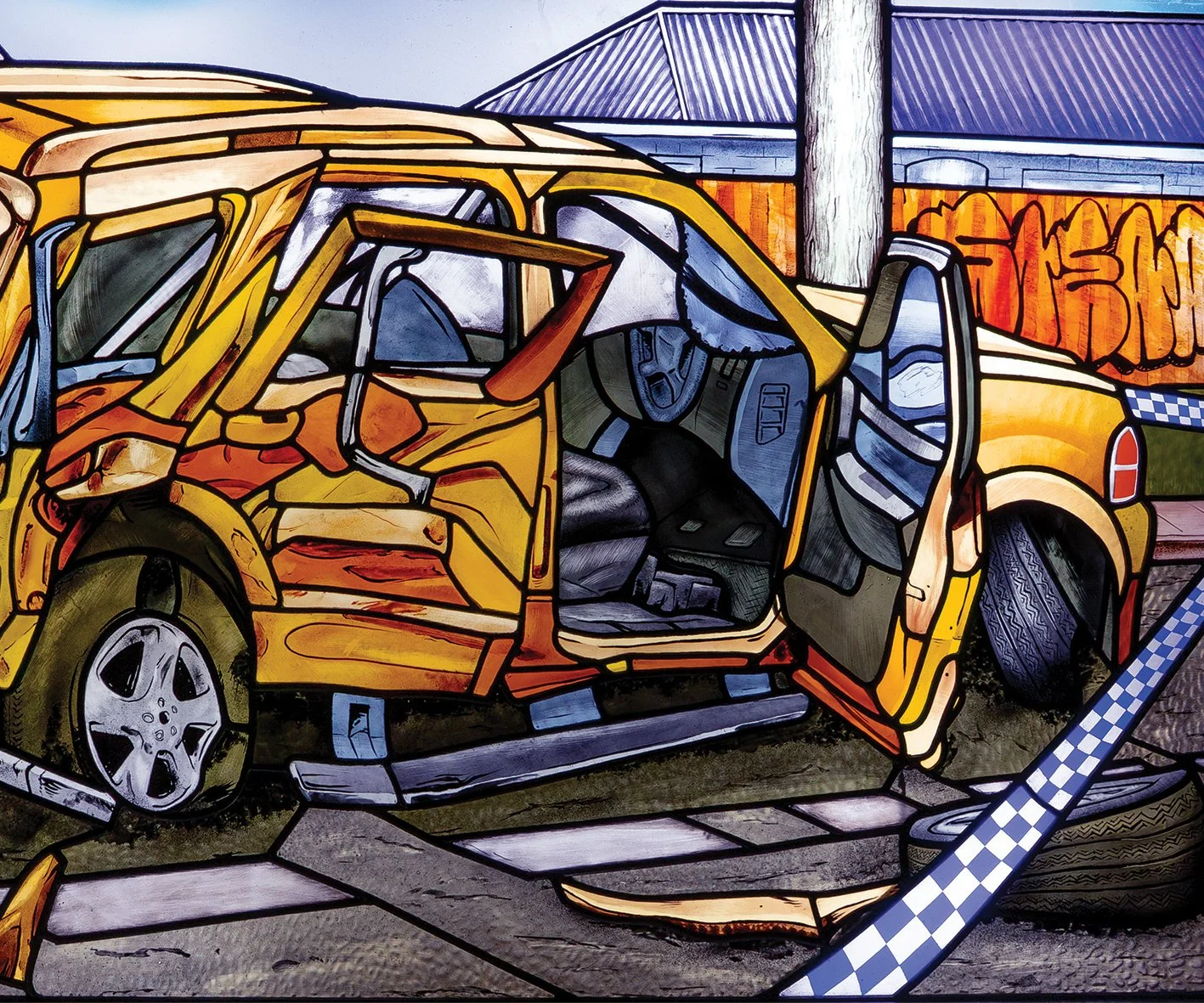
Photo: the artist
Jordan Benson (VIC)
Car Crash, 2025
Stained & etched glass leadlight
770 x 1400 x 70mm
Through Car Crash I sought to explore the aftermath of the often-instantaneous destruction of a car, what was once an object of great use has now an abstract reflection of its original form in an instant on the road. The remodelled shape of twisted metal provides visual interest with its bent panels whilst the sum of damage tells a story of what happened to it. As drivers we rarely witness the incidents but often encounter the aftermath which provides a stark reminder of the fragility of life and our vehicles and that otherwise feel so safe and secure.
Jordan Benson is a glass artist currently living in Melbourne, Australia. A design graduate of Gordon Institute of TAFE, Geelong, he holds qualifications in Glass and Glazing from Melbourne Polytechnic. Benson is enamoured with glass and its possibilities; 2D, 3D, opaque, transparent and everything in between, the possibilities are unlimited for anyone who is game enough to figure out the techniques. Benson’s primary art form is stained glass, albeit when the opportunity arises, he delves into any type of glass working, believing the crossroads of techniques is where the magic happens and is what drives him to experiment with the medium.
Working in stained glass, Benson draws upon his experiences of growing up in the urban environment of the city, and background in graffiti art, to counter traditional notions of stained glass as reserved for religious content and settings. Utilizing a dynamic illustrative format Benson’s work offers new possibilities and connections for a younger generation to engage with the tradition of stained glass.
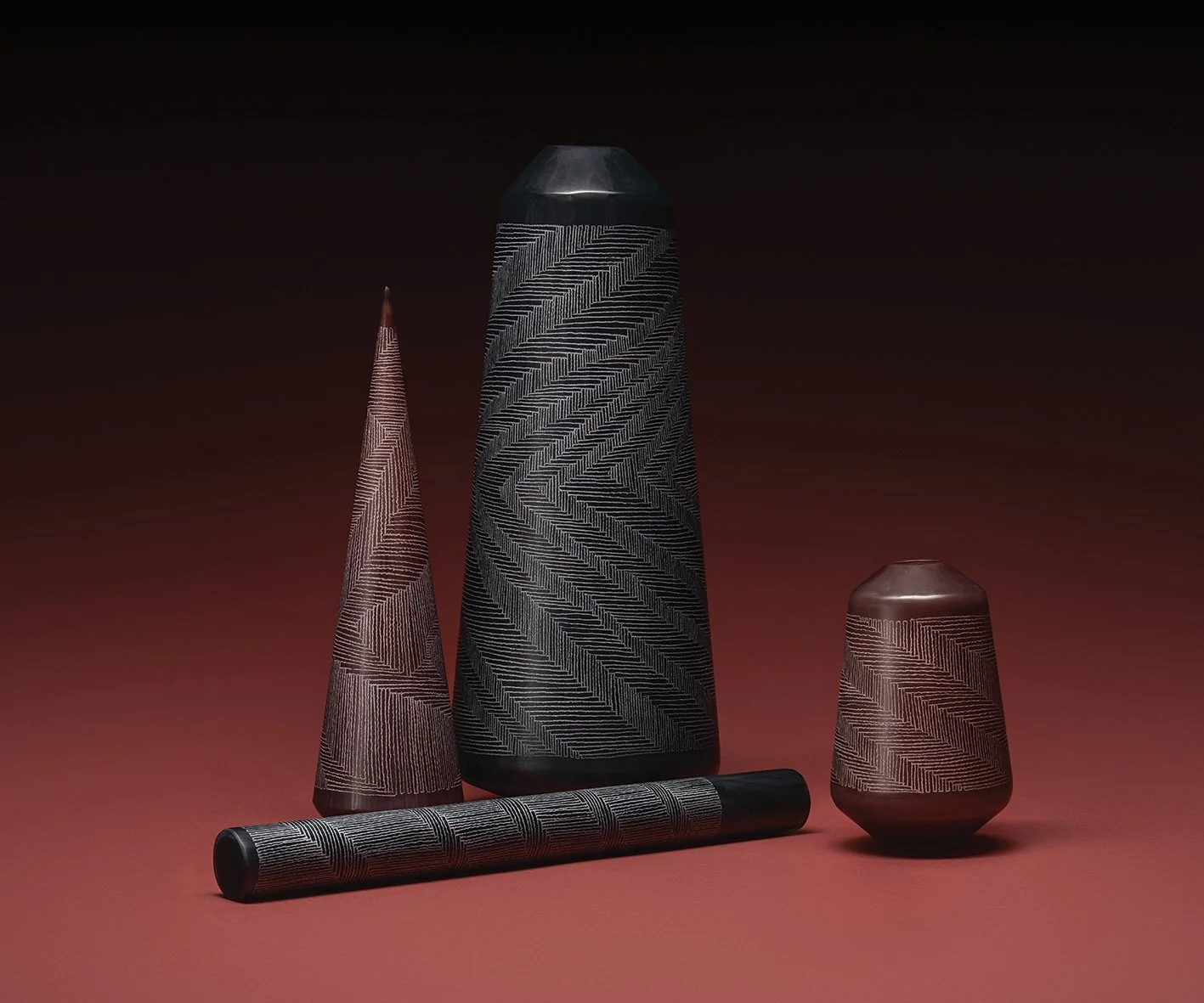
Photo: Connor Patterson
Bradley East (SA)
Field Notes from a Wandering Line, 2026
Blown, coldworked and engraved glass
380 x 380 x 380mm
Field Notes From A Wandering Line presents a series of forms in a composition emphasizing clean shapes and simple geometry. The work draws on Eve Kosofsky Sedgwick’s 1997 essay 'Paranoid reading and Reparative Reading' which critiques traditional critical theory’s role in avoiding new or superficial ways of apprehending the work of art, devaluing the surface and denying space for the happy possibilities that may come about when surprise is allowed to come into play.
Field Notes From A Wandering Line celebrates this potential of the surface as a myriad of possibilities. Each glass form is blown, meticulously cold-worked and then engraved, sitting in dialogue with one another and the viewer. The repetitive line-work (itself derived from Paul Klee's 1926 drawing 'Garden For Orpheus') evokes varying references and in such a way the forms become vessels for identity and meaning that playfully shift with each new encounter. The work invites reflection on what it means to take something at ‘face value’. Rather than positioning the surface as something to be penetrated.
Bradley East is a First Nations (Gamilaraay), queer multidisciplinary artist, designer and writer working predominantly in glass. Emerging from a background in graffiti and street art, East developed an interest in art history and theory after completing a diploma at Canberra Institute of Technology in 2016, and thereafter a BFA in Sculpture from RMIT in 2021. East has exhibited extensively across Australia in performance, painting, video, photography, sculpture and glass. His studies in queer theory and his positionality as an aboriginal man have informed his conceptual and process-based approach to making, utilising a drawing methodology in which repetition, mark-making and line form a canvas for his ideas.
East developed glassblowing skills whilst managing several private Melbourne studios, stepping onto the hotshop floor full time in 2023. In 2024, whilst working at Hot Haus Glass Studio, he was responsible for the development and launch of lighting brand, Haus Lights. Alongside his mentor Billy Crellin, East also helped establish and run Studio Dokola’s Footscray hotshop,. East is currently a glass associate at the JamFactory, Adelaide.
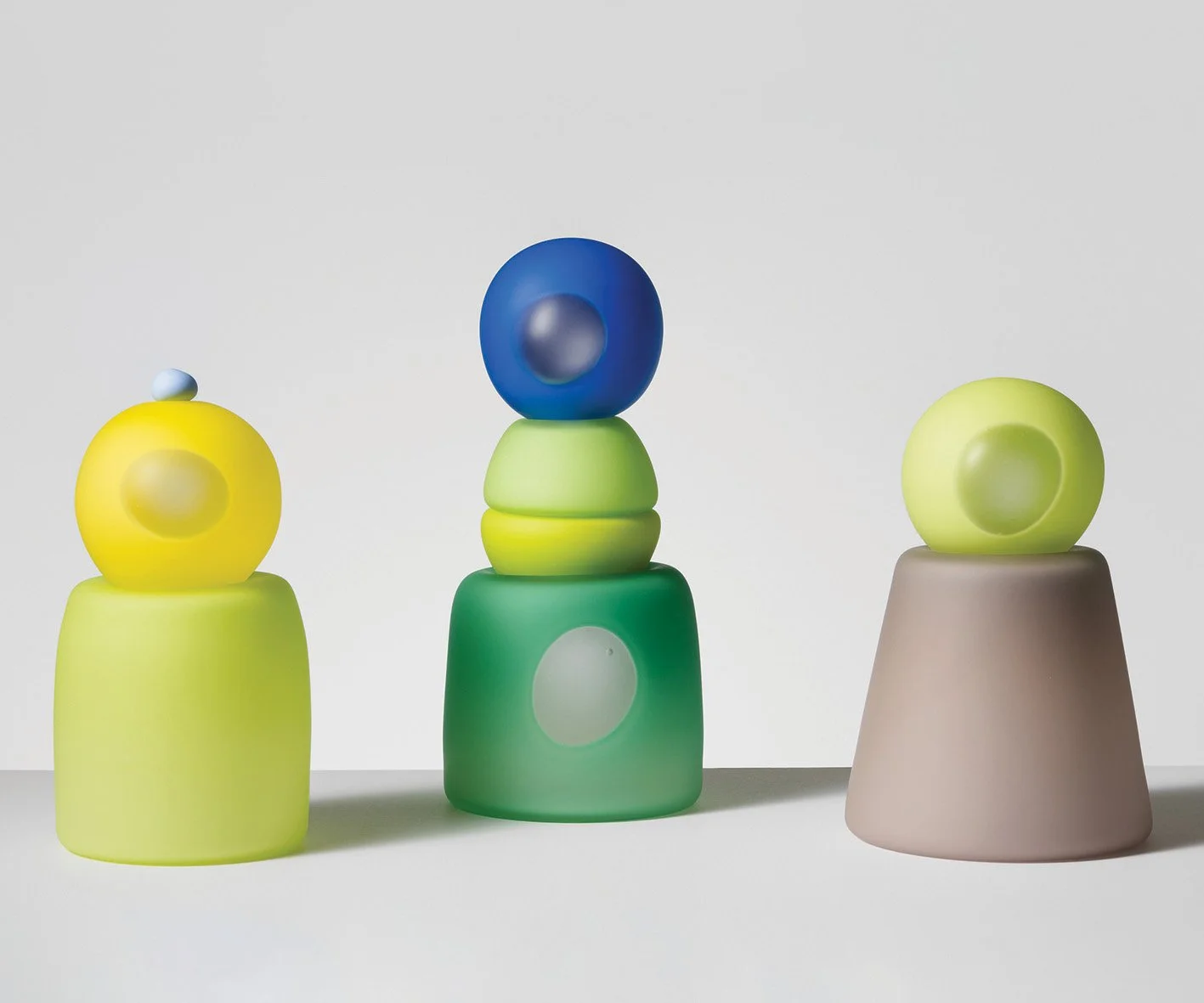
Photo: Connor Patterson
Bindi Nimmo (SA)
Grown Ups Allowed, 2025
Blown glass components, hot assembled, sandblasted surface finish
370 x 170 x 170mm, 475 x 200 x 200, 370 x 180 x 180mm
No Grown Ups Allowed draws on the strange, plastic dreamlands of early-2000s playgrounds. As a child, these surreal, brightly coloured environments felt like portals to another world — spaces defined by unfamiliar forms, saturated colour, and a sense of joyful curiosity. Their bulbous tunnels, warped perspectives, and synthetic textures created immersive, playful environments tinged with subtle disorientation, occupying a liminal space between fantasy and reality.
This body of work reimagines those formative experiences, translating fleeting sensory memories into sculptural form. The blown glass sculptures embody the elasticity of memory itself: vibrant, distorted, and simultaneously tangible. By inviting viewers to peer inside the objects, the works become thresholds for introspection, offering a quiet pause to reflect on the distance that often emerges between adulthood and childhood, and the layering of responsibility, self-consciousness, and restraint that can obscure instinctive play and imagination.
Bindi Nimmo is a glass artist from Whanganui, Aotearoa, currently practising on Kaurna Land. She holds a Diploma of Arts and Design from UCOL (Aotearoa). Following her studies, she was awarded competitive internships at Starworks in North Carolina, USA, and NZ Glassworks in Whanganui. These invaluable opportunities expanded her material knowledge and provided experience within professional glass studio environments.
Nimmo was subsequently selected for the Glass Associate Program at JamFactory in Adelaide, where she continues to advance her practice. Her work has been exhibited in Aotearoa, the United States, and Australia, and is held in private collections internationally. She was also included in the 2025 inaugural Adelaide Design Week.
Working primarily with blown glass, Nimmo investigates themes of nostalgia and human connection through the creation of tactile, memory-driven objects. Her work draws on organic and otherworldly forms, balancing technical rigour with experimental approaches to surface and form.
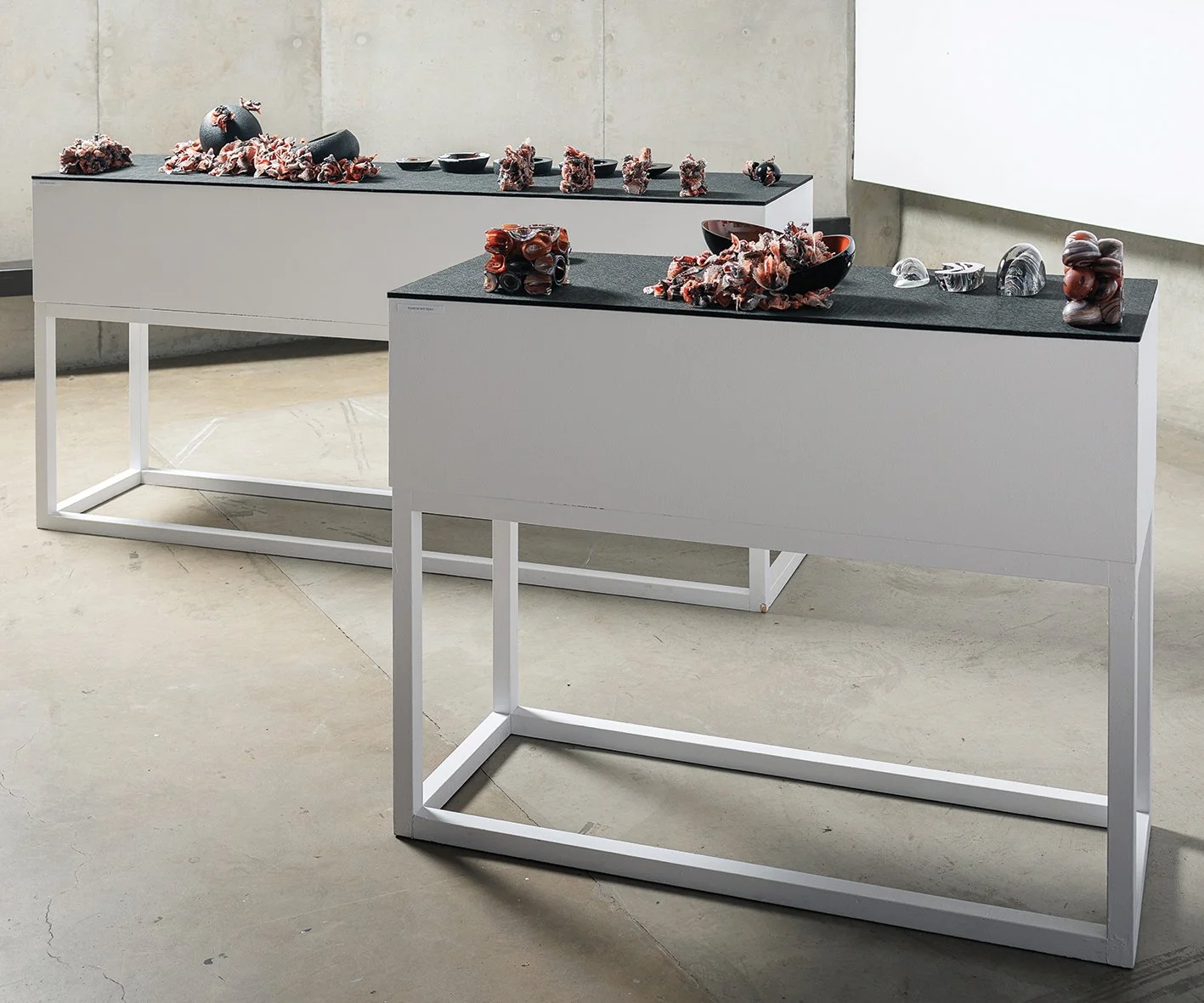
Photo: James Field
Isobel Waters (SA)
In the Absence of a Diagnosis, 2025
Kiln form, hot sculpted, blown and cold worked glass
300 x 3450 x 500mm
I have been searching- trying to understand what is happening to my body. In the absence of a diagnosis, I turned to glass making as a way of finding meaning - an attempt to ease the medical uncertainty I faced. Small moments of clarity have revealed themselves to me, but much remains unclear. So, for now I will continue to create, trying to make sense of it all.
Isobel Waters is a visual artist working on Kaurna Country in Adelaide, South Australia. Her practice is informed by her experience as a health care worker, where she engages with the physical and emotional complexities of the human body. This clinical background continues to shape Waters' approach to material and form, driving a practice that interrogates personal and socio-political dimensions of health, care, and embodiment.
Working across glass blowing, kiln forming, flameworking, cold working, and assemblage, Waters' aims to create emotive pieces that explore the fragility, strength, and adaptability of the body. Varying from intimate compositions to large scale installations, Waters' work often invites interactive or immersive viewing experiences, encouraging audiences to reflect on their own physicality, gender, the broader systems that govern healthcare, and the human condition. Through layered processes and tactile surfaces, Waters aims to evoke the rawness of bodily experience—scars, tension, healing, and resilience. Her work exists in a space between art and anatomy, where glass becomes a medium for empathy, critique, and transformation.
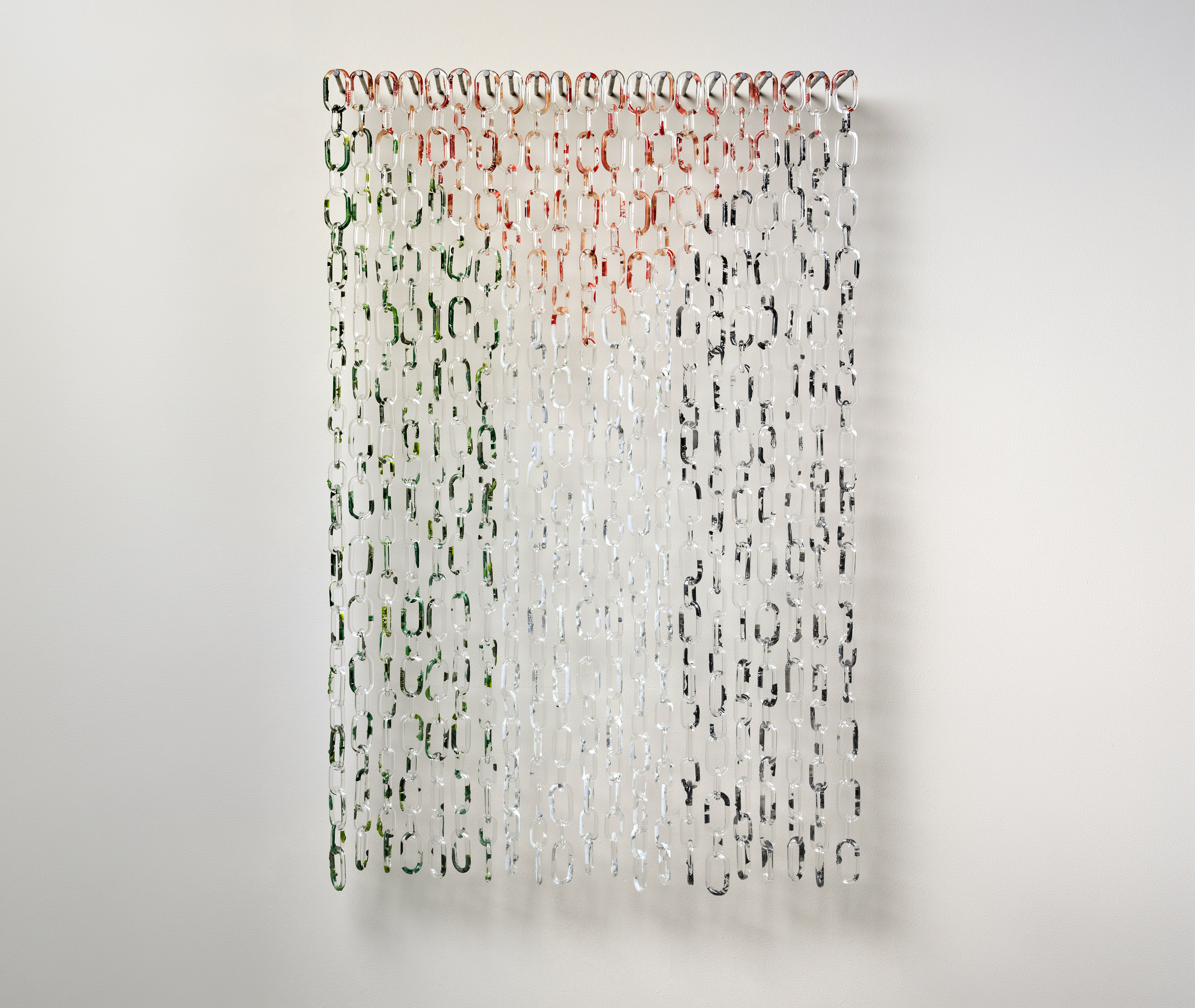
Photo: Breton McGeachie
April Widdup (ACT)
With (Hold), 2026
Borosilicate glass, enamel paint
950 x 630 x 30mm
Glass, as a material bound to sight, is a lens through which histories are seen, obscured, or reframed. Its material transparency establishes a boundary that may be seen but unable to be crossed.
Chains operate in dual tensions: signifying endurance, love, and collective strength, while equally evoking oppression, captivity, violence, and constraint. Fragility and resilience coexist, a diptych of continuity and possible rupture, echoed through glass’ materiality.
Transparent links are coated in opaque enamel - crackled, peeling, and suspended between moments of becoming and unbecoming. It is the texture of transformation, decay, and flux.
Traditionally a soft, flexible fabric, the flag is here remade out of glass chain. What is usually a surface becomes a structure that binds, where each link depends on another for support. It no longer moves freely or rests lightly, but carries weight, rigidity, and risk.
April Widdup is an early-career multidisciplinary artist from Australia, living and practicing on Ngunnawal and Ngambri Land in Kamberri / Canberra. Widdup holds a Bachelor of Visual Arts [2022] with a major in glass and a minor in anthropology from the Australian National University School of Art and Design. As a queer non-binary artist, Widdup creates work that invites audiences into dialogue with human condition and the politics of space. Widdup’s practice spans sculpture, installation, video, and sound, and centres the lived experiences of minority bodies navigating sites designed to isolate, regulate, or exclude. Recurring themes of identity, mobility, memory, phenomenology, power, and control shape their work. Through an examination of interpersonal relations, built environments, and geopolitics, Widdup explores how social structures inform our understanding of life and death, revealing the tension between individual agency and collective systems.
Established Artist Finalists
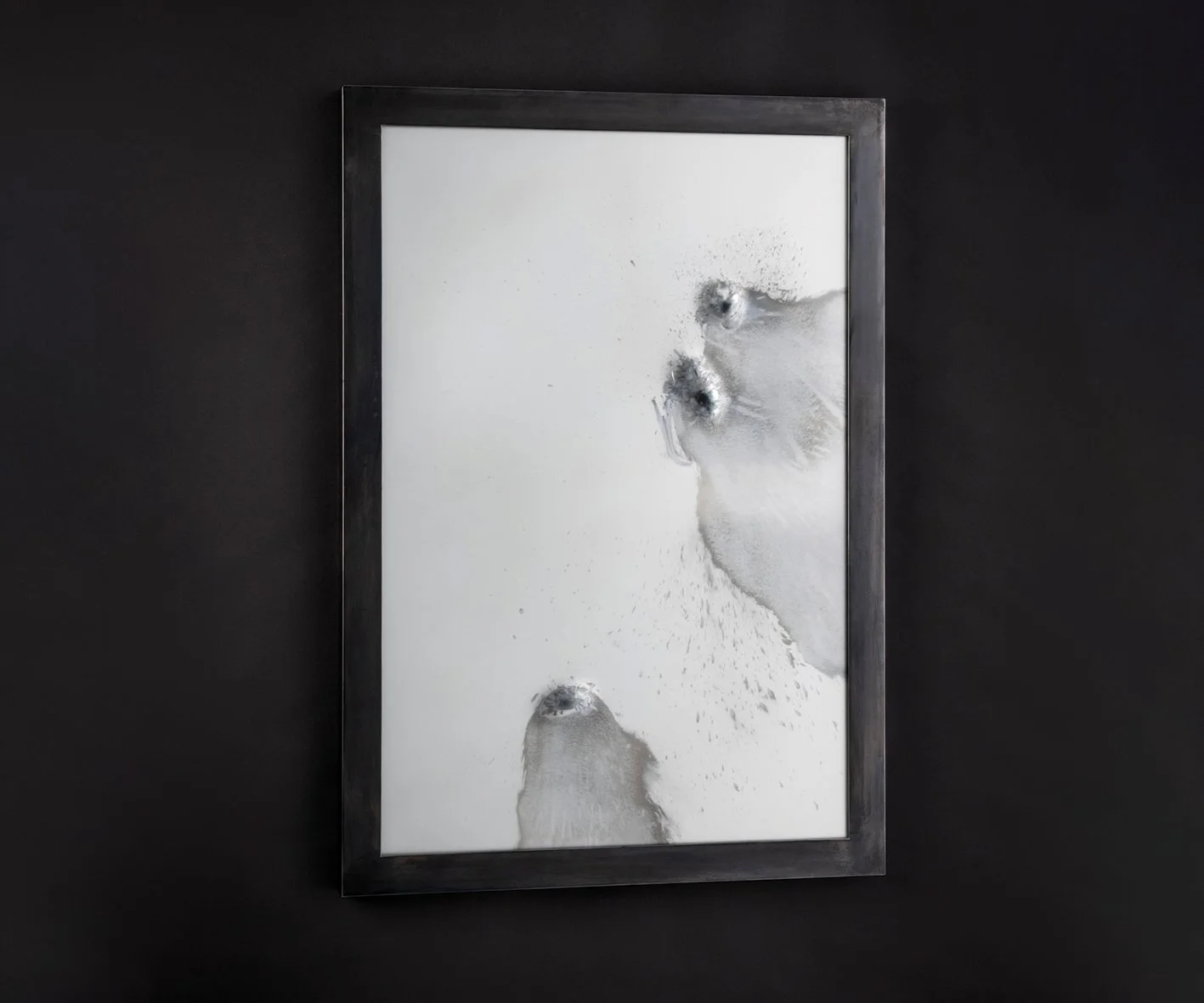
Photo by Michael Haines
Gabriella Bisetto (SA)
Under my skin (blooms), 2025
Silvered, kiln formed glass, metal, 1000 x 800 x 50mm
My work explores the complexities of the human body, reimagining its internal systems through material and sculptural forms. My fascination with science and biology informs my practice, particularly the intricate ways cells, systems, and physiological processes shape our physical existence.
This body of work moves from the interior of the body to its outermost barrier, focusing on skin as both visceral, tactile boundary and a conceptual surface. I draw on the myth of Narcissus, to interrogate reflection and self-awareness, exploring skin as a vital site of transient and evolving identity. This work examines how skin is perceived, experienced, and transformed over time, through utilizing glass’s ability to flow into viscous states, reflect, and morph through heat to capture these transformative qualities and explore perception, identity, and the mutable nature of the body.
Through this lens, I seek to investigate how we come to know ourselves and how closely our identities are tied to the surface of our skin—a dynamic boundary bridging the inner self and the external world, where science, myth, and material form intersect.
Gabriella Bisetto is a practising glass artist. Born on Wiradjuri Country in Griffith, NSW, Gabriella trained at the Canberra School of Art before relocating to Adelaide (Kaurna Country) to undertake the JamFactory Glass Studio Associate Program. She later worked as Production Manager of the JamFactory Glass Workshop before joining Adelaide University where she works as a Senior Lecturer.
Gabriella’s artistic practice is deeply rooted in the body—its fragility, complexity, and the quiet space between breath and being. Her work explores the tension between science, religion, and the visceral human form. With over three decades in the field, Bisetto has made a significant contribution to contemporary glass and visual art in Australia. She has served on boards for Ausglass, Asia-link, and Create, undertaken artist residencies and been invitated to address international forums. Bisetto was awarded the Tom Malone Prize in 2016 and 2025. Her contribution to teaching was recognised with a UniSA Teaching Award (2016) and an Australian National Teaching Award (2017).
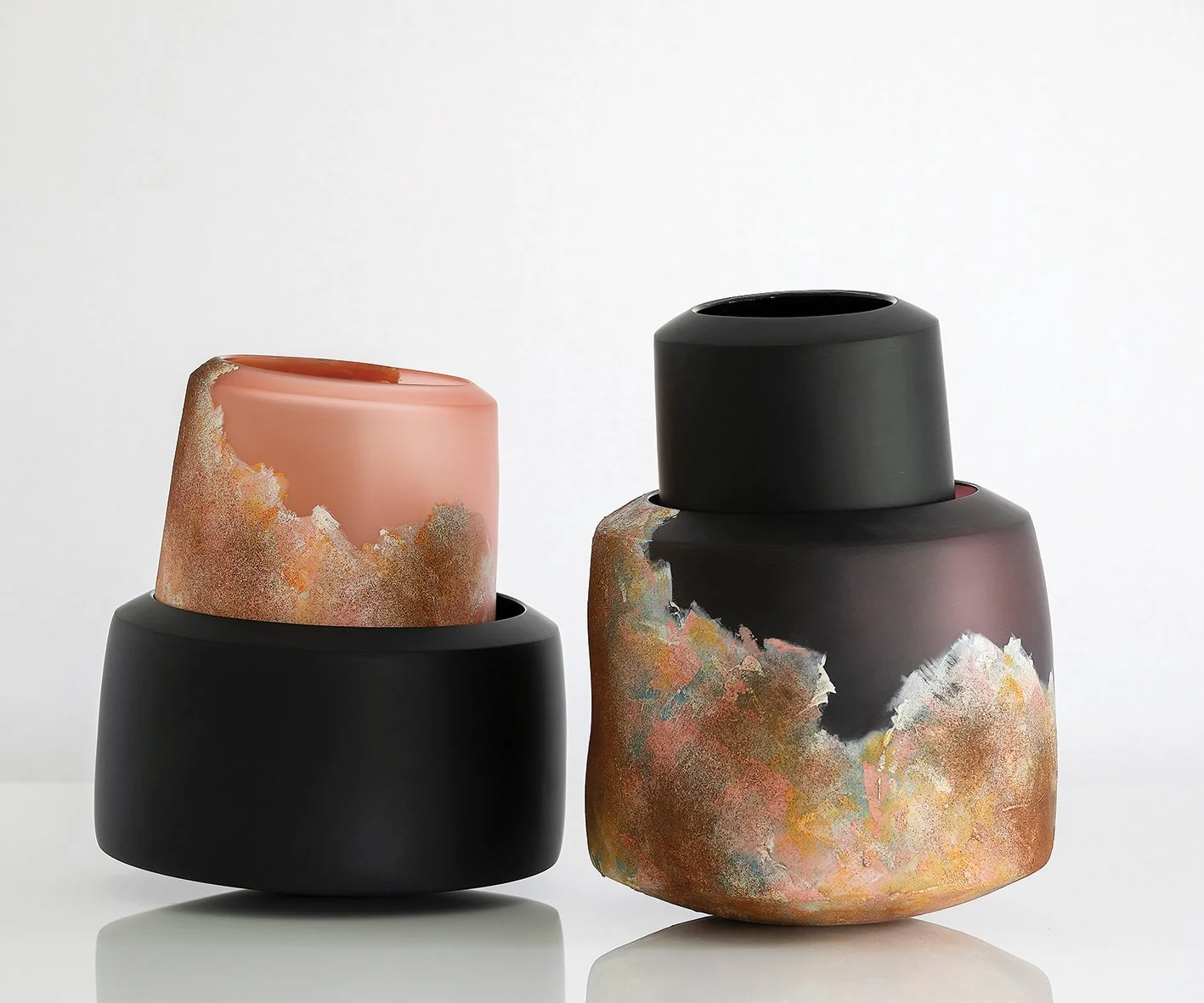
Photo: Adam McGrath
Annette Blair (NSW)
Remnants of Time - In Idleness, 2026
Blown, cold worked, enamelled and rusted glass
460 x 750 x 500mm
Remnants of time – In idleness continues my reflection on the quiet life of objects and the human rhythms they absorb. I am drawn to forms that feel familiar and unassuming; vessels that might once have been useful, handled daily, then gradually set aside. In their idleness, they begin to speak differently. They hold not only traces of touch, but also absence, pause, and the slow movement of time.
This work considers what lingers when function falls away. I am interested in the space between care and neglect, preservation and decay, where objects exist in quiet suspension and memory rests within memory.
Surface becomes a language of accumulation. Through layers of enamel and the gradual oxidisation of embedded metal, I allow time to remain an active collaborator. Rust blooms slowly and unpredictably, extending the work beyond the immediacy of making. Scratches, abrasions, and softened edges evoke the tender erosion of use, marks that are not damage, but evidence of presence.
Glass allows me to explore the intersection between fragility and permanence. Each element is the result of thoughtful engagement with heat, time, and material knowledge, an exploration of both process and poetics. In this work, the vessel becomes a quiet archive, embodying time as something intimate, incremental, and deeply human.
Annette Blair is a glassmaker based in the Canberra region. She completed a Bachelor of Arts (Honours) at the Australian National University School of Art in 2004, before relocating to Adelaide to undertake the JamFactory Associate Program in the Glass Studio. She returned to Canberra in 2008, where she continues to grow her diverse practice in both her own studio and at Canberra Glassworks.
Blair has dedicated her practice to refining technical processes to create works that celebrate the beauty and movement of glass as a material, while exploring the connections we have to people, objects, and place. Blair’s work has been widely recognised, including as a finalist in the Ranamok Glass Prize, the Tom Malone Prize, The Still: National Still Life Prize, and the Woollahra Small Sculpture Prize. In 2022, she was awarded the Vicki Torr International Year of Glass Prize. Her work is held in both private and public collections. Most recently Blair completed a commission for Canberra Glassworks at the Australian War Memorial.
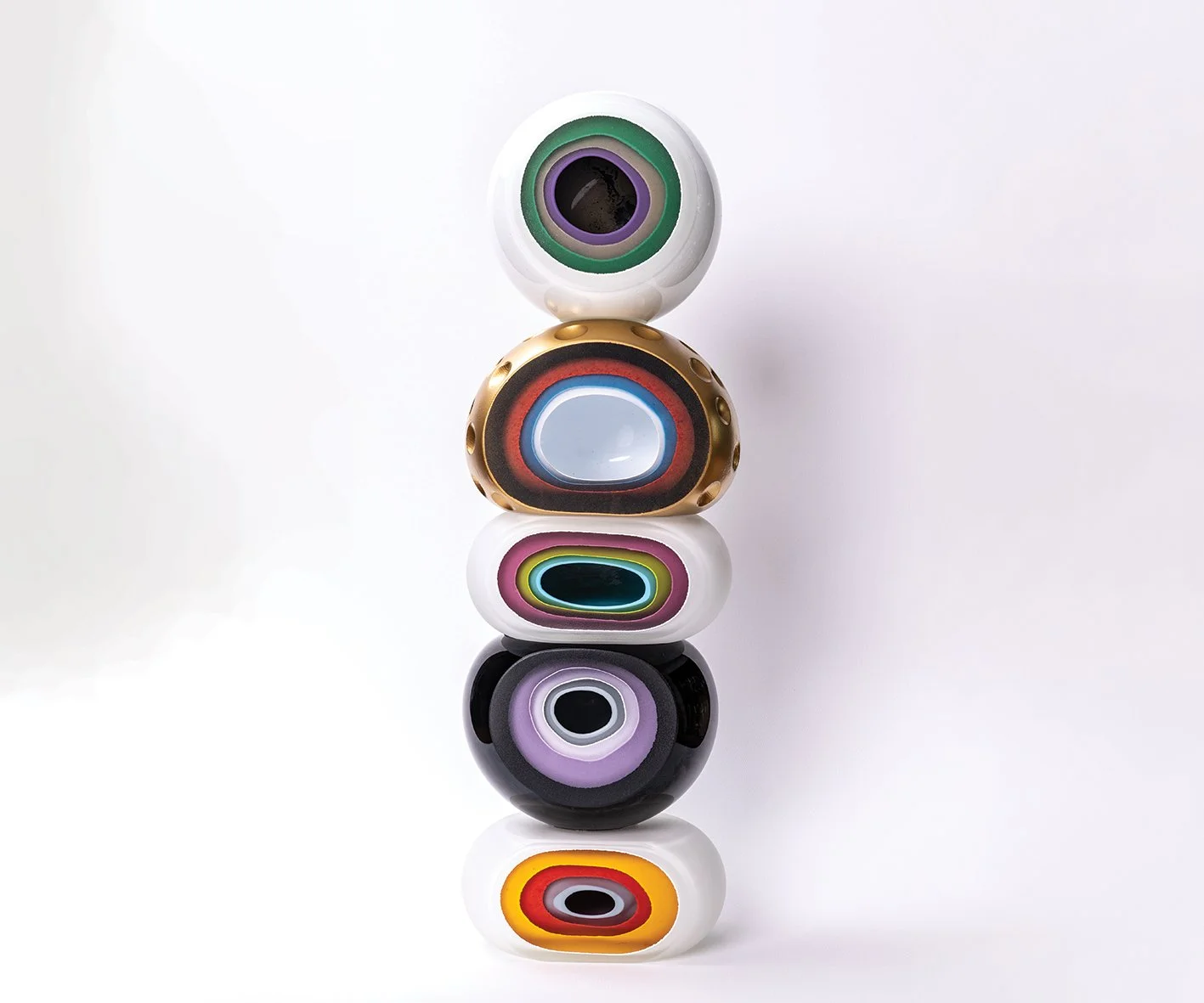
Photo: Mark Brimblecombe
Dominic Burrell (NZ)
Isobar, 2026
Hand blown glass, colour overlayed, diamond cut and drilled, gold enamel, fused
500 x 160 x 130mm
My work explores elements of form and balance using colour bands and tonal variance as the key transition device. I am drawn to the aesthetic placement of design principles - point, line and plane. In essence my works are roll-ups of colour layered in varying thickness which allow the colour to emerge like memory through the various interventions of occlusions, spatial depth, tone and hue.
Dominic Burrell was born in Nelson, New Zealand. He studied Social Science at Otago University, followed by Interior Design, before graduating from Whanganui Glass Design School. He has held solo and group shows throughout New Zealand. His work is held in various public and private collections in the USA, United Kingdom, New Zealand , Hong Kong and Australia, including in prominent private collection of New Zealand Prime Minister John Keys and Sir Elton John.
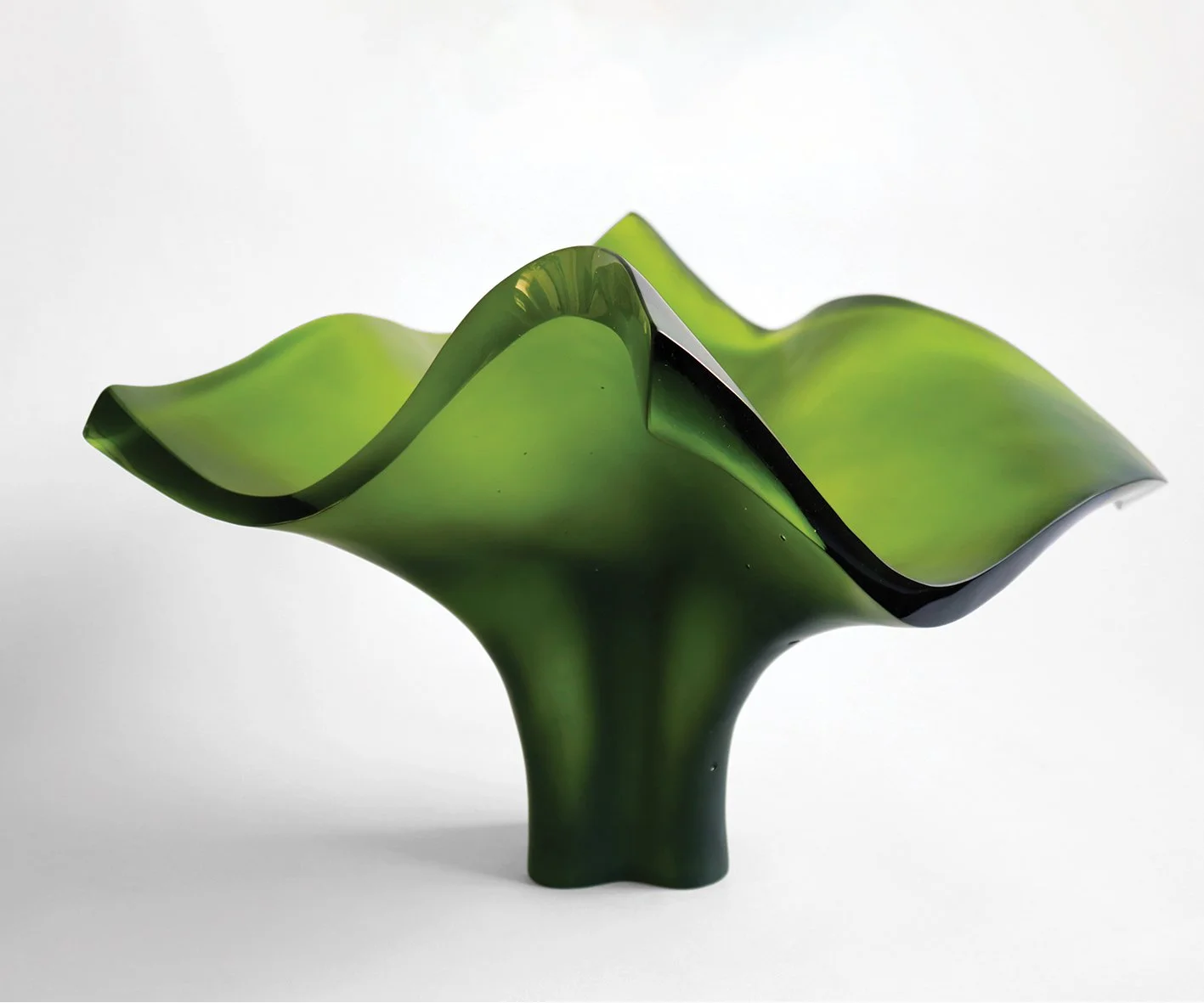
Photo: the artist
Christine Cathie (NZ)
Folded, 2026
Cast Gaffer glass
280 x 360 x 360mm
I use the lost wax process in cast glass, a very process-driven technique, and show evidence of that process in the exploration and making of this work. By gently persuading the soft warm wax to twist and curve, I create smooth shifts of angle and thickness. Concave surfaces shift to convex, flowing curves meet sharp edges, and a contrast in finish allows the glass to show its luminosity - creating a tension between fluidity and structure that capture a sense of movement. I aim to evoke an abstracted sense of the earth’s folds, echoing my local environment of Matakana with its softly moulded hills, rich colours, and the shifting light and shadows of our native bush.
Christine Cathie has been casting glass since 2000. She exhibits throughout New Zealand and has gained an international reputation, exhibiting in Australia, Hong Kong and the USA. Her work is included in the collections of Te Papa Tongarewa, Museum of New Zealand, at embassies for the Ministry of Foreign Affairs, New Zealand, Palm Springs Art Museum, USA, Glasmuseet Ebeltoft, Denmark
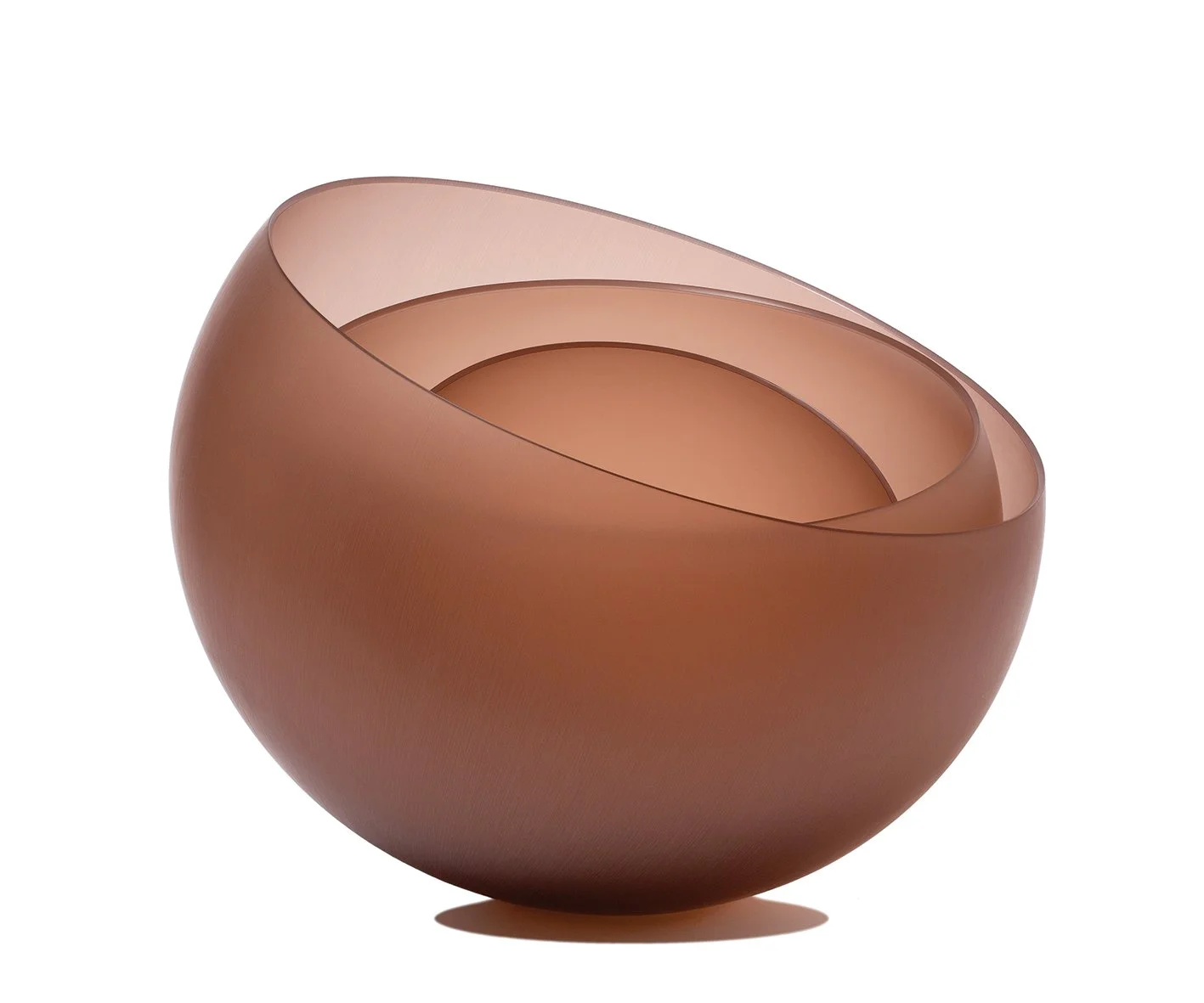
Photo: David Paterson
Mel Douglas (ACT)
Penumbra, 2026
Blown, cold worked and engraved glass
400 x 400 x 400mm
Penumbra explores how space emerges through both form and absence. As elements overlap, they create shifting shapes and quiet intervals - spaces that hover between what is visible and what is implied. These suggestions extend into the surface itself, where the engraved lines open the plane and invite depth. Through overlap and incision, space is compressed and released, allowing a three dimensional presence to unfold.
Mel Douglas has worked as an independent studio artist since 2000. She holds a PhD from the Australian National University for practice-lead research investigating how studio glass can be understood through the aesthetics of drawing. Douglas is the recipient of several prestigious awards including the Tom Malone Prize, 2014 and 2020, the Ranamok Glass Prize in 2002, the International Young Glass Award in 2007 from Ebeltolft, Denmark. In 2022 Douglas was a finalist in the Loewe Craft Prize, and in 2023 Douglas was Honorary Artist – Art of Fire at Pittsburgh Glass Center, USA.
In 2019 Mel Douglas’ work was the inaugural acquisition for the National Gallery of Australia’s’s Robert and Eugenie Bell Decorative Arts and Design Fund. Douglas’ work is held in both private and public collections internationally, including the Corning Museum of Glass, New York, the Chrysler Museum of Art, Norfolk, VA; the Ebeltoft Museum of Glass, Denmark, the Art Gallery of Western Australia and National Gallery of Australia, Australia.
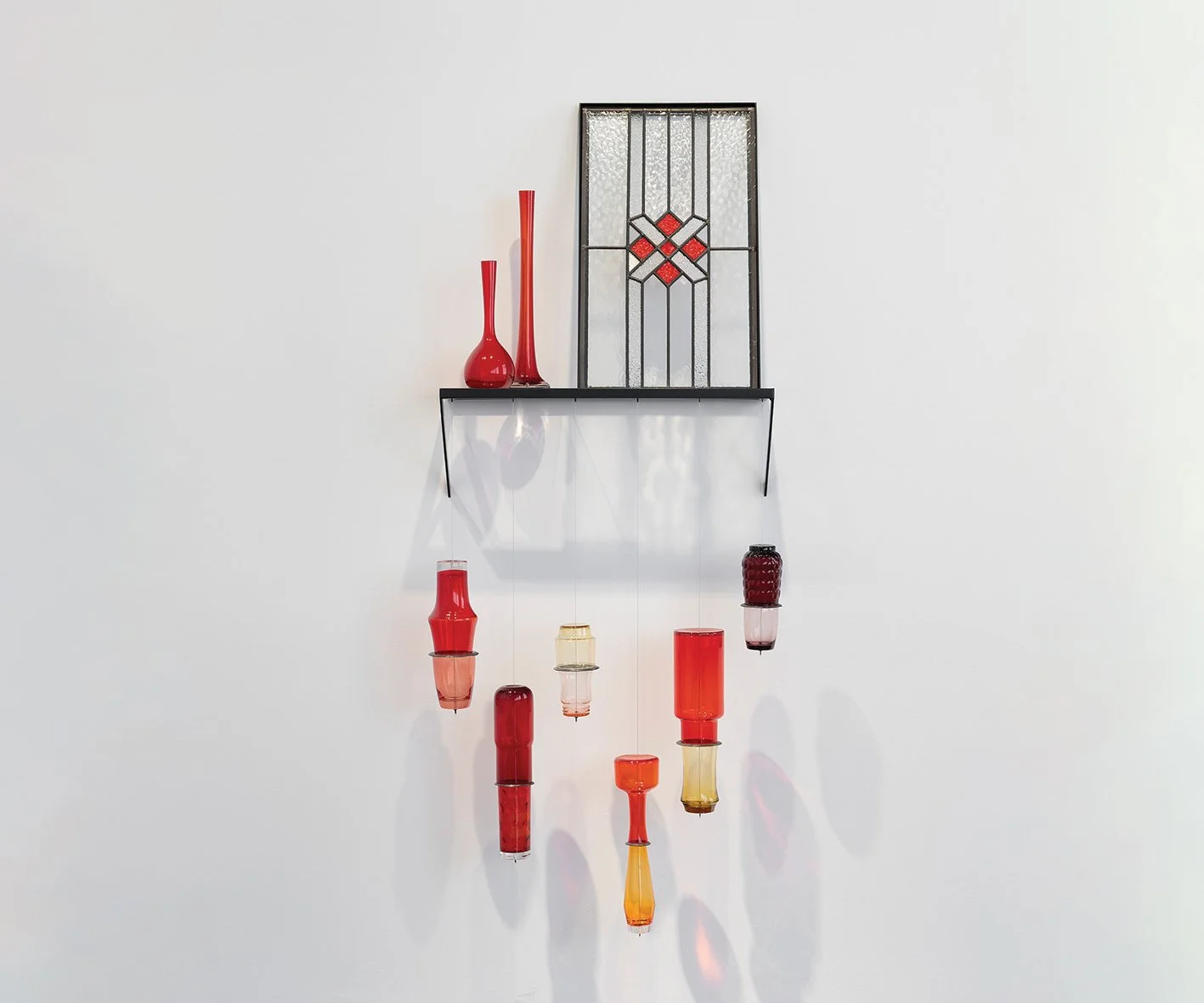
Photo: Tolarno Galleries
Nicholas Folland (SA)
Red Wednesday, 2025
Found glassware, found leadlight, lead, steel
1630 x 700 x 200mm
My work consists of sculptures and installations from ready-made and recycled domestic objects. As an obsessive hoarder, I have amassed thousands of crystal objects to construct fragile landscapes that hover in space and reconfigured chandeliers that become slowly encrusted in ice. Most recently I have been drawn to a growing stockpile of discarded leadlight windows, and gleaned second-hand coloured glassware, to create compositions imbued with memory and desire.
“Here, leadlight panels – the type featured in kitchen cabinets found in homes a century ago – are freed from their classification as furniture. These often jaunty glass compositions, bordered with lead, jostle with found domestic glassware. Drinking vessels and vases that would have once been ‘homed’ in the leadlight fronted cabinets are upturned, conjoined, repositioned and suspended to form unhomely arrangements.”
Lisa Slade - Hugh Ramsay Chair in Australian Art History at the University of Melbourne
Nicolas Folland is a graduate of the University of South Australia and the University of Sydney, and has worked within the research programs of the Piet Zwart Institute, Rotterdam and the University of Barcelona. Folland’s work is held in major collections, including of the Art Gallery of South Australia, The National Gallery of Victoria and the Museum of Contemporary Art, Sydney. He is currently Head of Sculpture and Head of Contemporary Studies at Adelaide Central School of Art and is represented by Tolarno Galleries Melbourne.
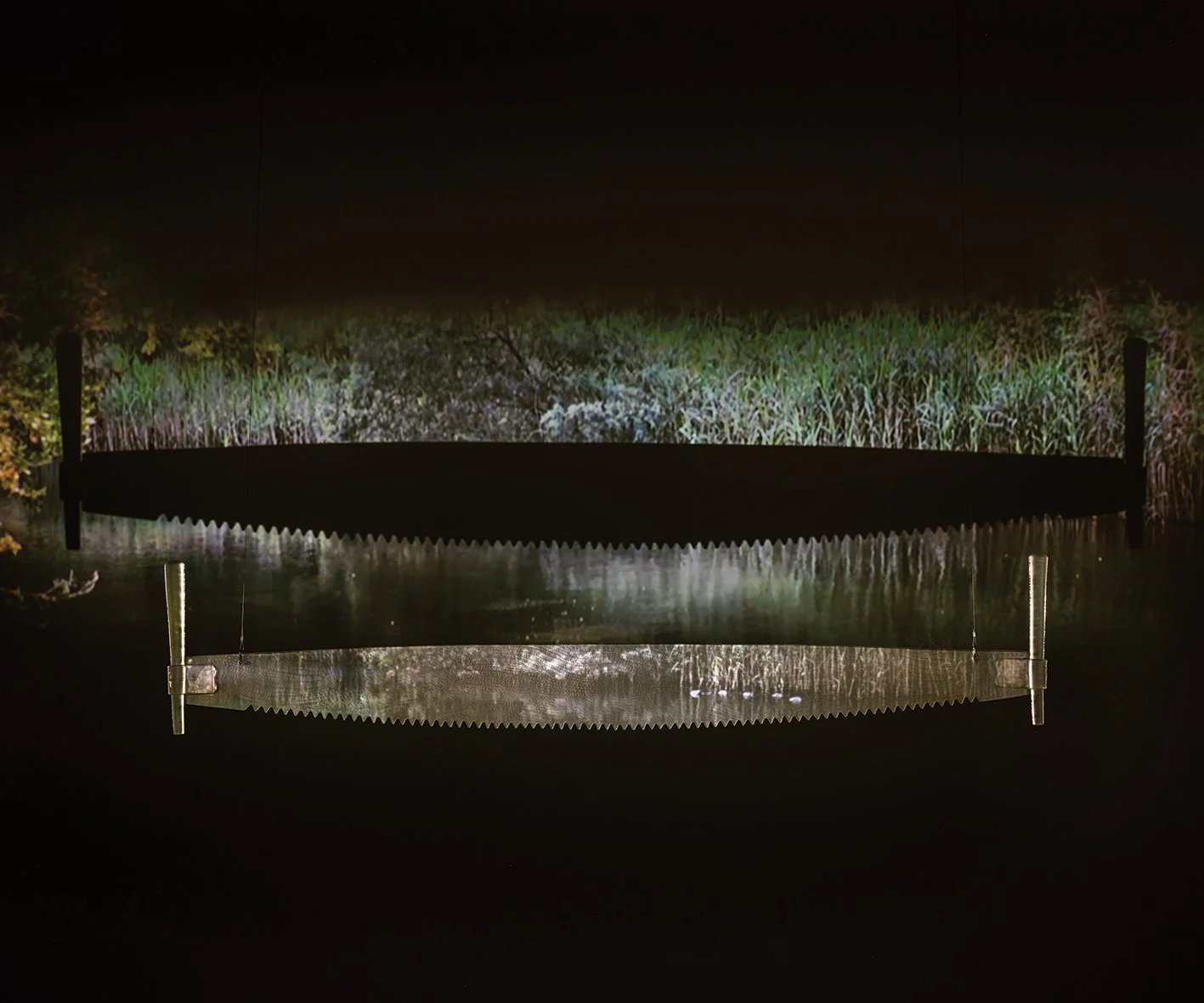
Photo: David McArthur
Holly Grace (NSW)
Clearing, 2026
Glass saw blade is made from blown sheet glass and hot sculptured handles, wall projection
and sound recordings from artist supplied video projector
250x 1300 x 30mm
‘Together we build, pulling and pushing, working together our sawblade in constant motion. A saw’s edge is both the future and the past a sharpened blade we draw across the land. To clear is both an act of building and of destruction, emptying of a place is to empty it of life. Life something as fragile and ethereal as glass.’
Clearing is a suspended glass two man wood saw with a projected surface and shadow. It was inspired by my recent participation in the Sharing Stories Art Exchange. A creative field project of the Environmental Art program at Australian National University, the Sharing Stories Art Exchange focuses on connecting the Canberra community with local indigenous communities. Using both the camera and a collection of glass acoustic horns I have created visual and audio record of the Kosciuszko National Park, its river systems and the effects of climate change and the Snowy Hydro Scheme on a unique and fragile landscape.
Holly Grace was born in Perth, Western Australia and is currently based in Queanbeyan, NSW. Grace has exhibited widely in Australia and internationally including art fairs: Sydney Contemporary, Melbourne Art Fair, London Art Fair, Sofa Chicago. The artist has been collected by various public and private collections, including the National Gallery of Australia, Artbank, Parliament House Art Collection and Canberra Museum and Gallery.
Holly Grace has been the recipient for grants from the Australia Council and Arts Victoria that enable her to create new bodies of work and to participate in three International Mentorships. Two of these mentorships took place in Denmark and initiated the artist’s affinity with the landscape, leading to more recent explorations into the Australian Bush. Exploring first with the camera and then with glass, Grace creates a multi-layered glass canvas that is a poetic interpretation of the Australian landscape.
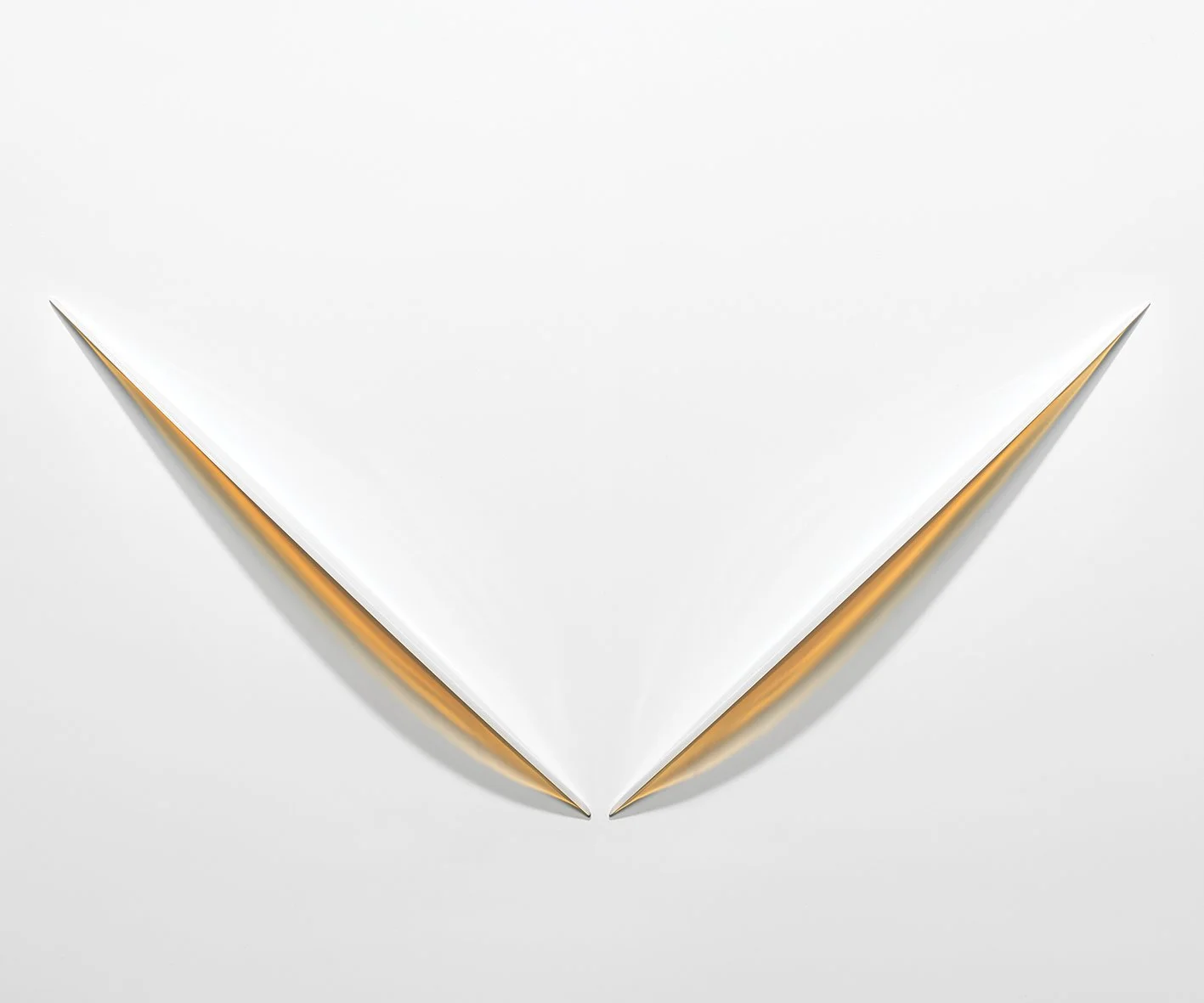
Photo: Grant Hancock
Jessica Loughlin (SA)
bird in space V, 2025
Glass
490 x 970 x 90mm
bird is space is an ethereal piece made with light. It is a form without form, visible but not solid - influenced by the nature of light in our sky.
It is created using opaline glass and light. Opaline glass mimics our atmosphere, separating light into cool and warm colours. The glass only allows the warm spectrum of light to filter through. In this work, the light passing through the glass illuminates the wall with a warm glow, while the glass itself, almost disappears
This piece’s name pays homage to one of my early inspirations, Brancusi’s ‘bird in space,’ its exquisite form creates space from form, elevating into the sky.
Jssica Loughlin’s work prompts a mediative reverie influenced by her fascination with the beauty of emptiness. Her work is characterised by a reductive sensibility and technical refinement in kiln formed glass. A leading Australian artist, Loughlin’s practice stretches over 25 years with her work widely recognised and exhibited in Australia and internationally. Loughlin’s work has been awarded multiple prizes and is part of major public collections, including the National Gallery of Australia, Art Gallery of South Australia, Corning Museum of Glass, New York, and the Victorian and Albert Museum, London UK.
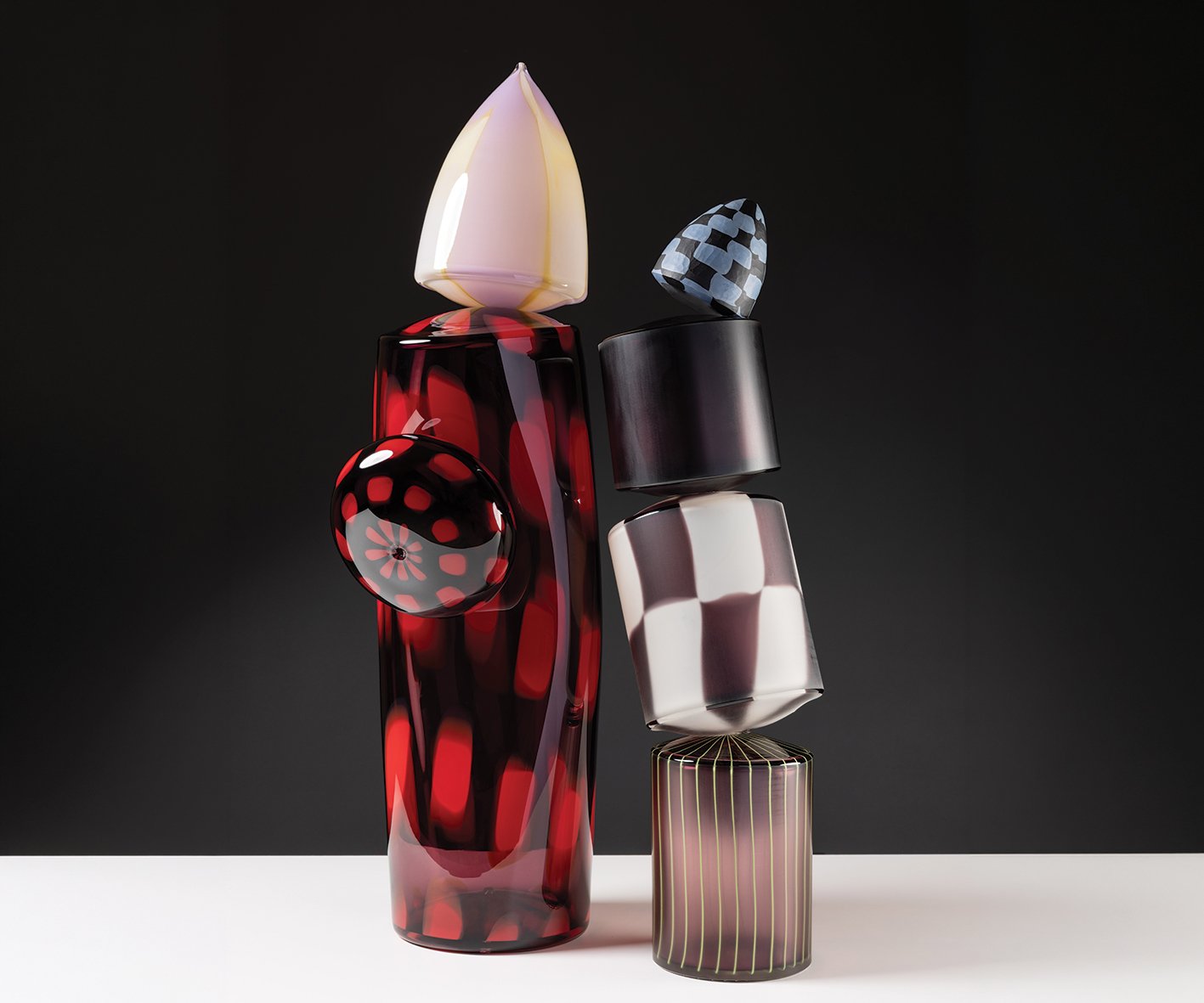
Photo: Pippy Mount
Nick Mount (SA)
Ramblers #010226, 2026
Hot glass, murrini, surface worked, assembled
620 x 330 x 150mm
In these most recent pieces, I place carefully crafted and sometimes seemingly random glass forms in composition with components of varying formality and materiality, offering a purposeful perspective and considered narrative.
The arrangement of objects expands the story of the composition telling of routine and repetition that values handwork and is driven by materials and process.
Nick Mount was among the first generations of Australian artists to be introduced to the glass medium in the 1970s. His longevity as a leading glass artist and designer is a testament to both his virtuosity with the medium and his intuitive ability to let it speak for itself. Grounded in the historic and cultural traditions of Venetian glassmaking, inspired by the collaborative ethos of the studio glass movement, and enriched by engagement with local and international glass communities, his work tells a distinctly Australian story. It is a narrative shaped by partnership and persistence, industry and innovation, experimentation and growth. Renowned for combining technical mastery with a playful, exploratory spirit, Nick remains deeply committed to investigating beauty, utility, and process through glass.
Nick Mount has exhibited extensively, presenting solo exhibitions and participating in major group shows throughout Australia and internationally.
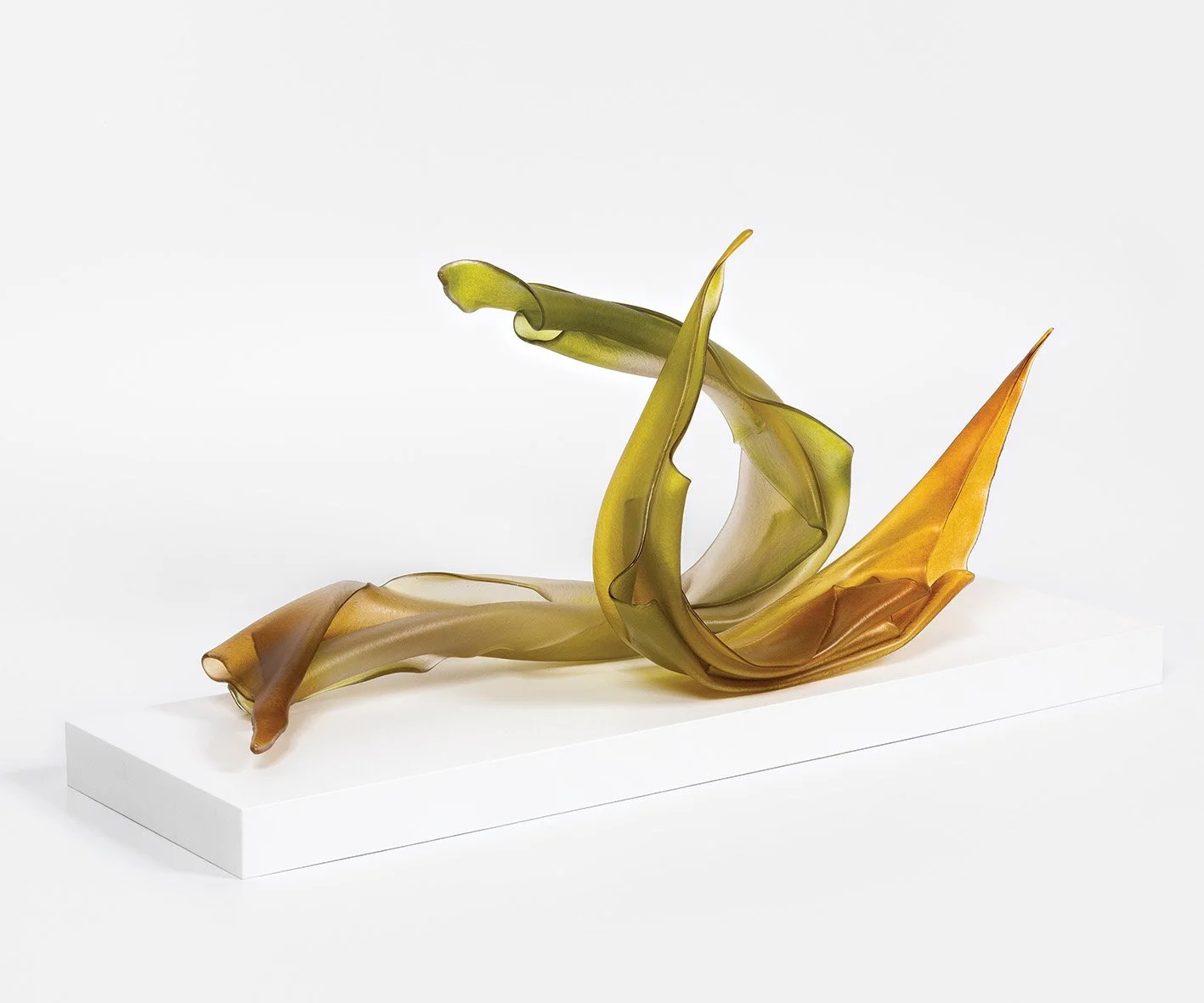
Photo: courtesy of the artist
Kirstie Rea (NSW)
Shaped by the Breeze 2, 2024
Glass, low painted plinth
365 x 750 x 250mm
This work abstracts the awe and surprise that is found in nature, in the bush, in the garden; things that delight and offer us a sense of wonder. They also speak of the possibilities of both firm and fragile connections that we have to certain places.
Embracing and acknowledging the beauty of open spaces, of entangled places, of passages through and places beyond, moments of reveal, of repose and of sensory residue lie within.
Kirstie Rea is an idependent studio artist working in Kamberi/Canberra, whose practice is embedded in the contemporary glass world. Teaching and mentoring new generations of glass artists has played a major role in Kirstie’s arts practice. She has taught in her field of kiln formed glass and cold working techniques across the world since 1987.
Kirstie’s practice has been recognised by several awards including the Ausglass Honorary Life Membership Award (2009), the artsACT Creative Arts Fellowship (2004), the CAPO Fellow Award (2014), and the Canberra Glassworks Fellowship (2016). In 2023 she was awarded one of eleven Craft Master Awards from the World Crafts Council Asia Pacific Region and is a finalist in the 2026 Loewe Foundation international Craft Prize.
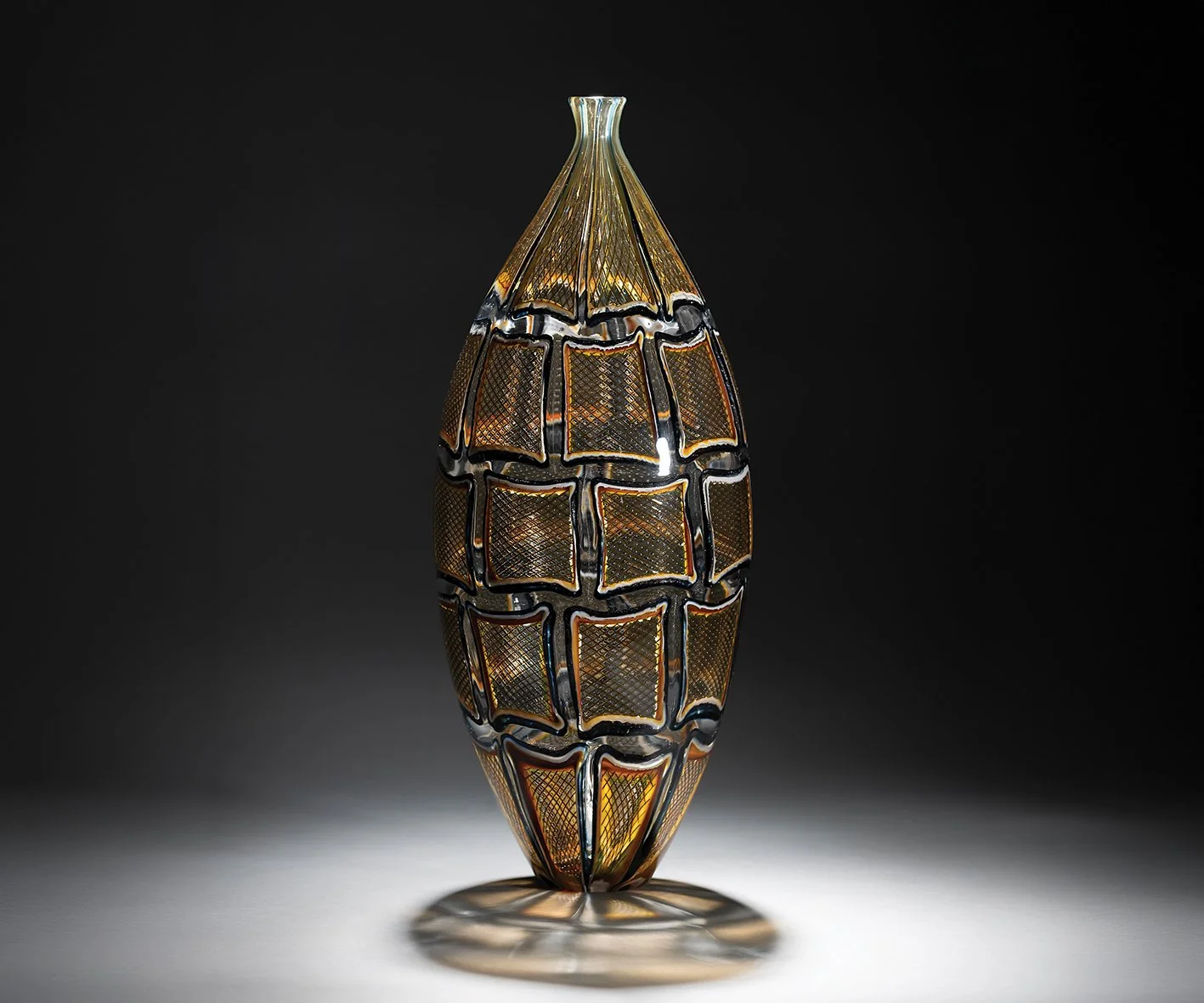
Photo: Adam McGrath
Tom Rowney (NSW)
Open Reticello, 2025
Blown glass
580 x 240 x 240mm
Throughout my blowing career, I have strived for perfection and honing my skills with blown glass, always looking for the most difficult of techniques to master. I like my work to create question and wonder as to how it has been made, thus engaging the viewer on an additional level, beyond the obvious display of colour and pattern.
In this piece Open Retticello I am combining the tight skills of making retticello, a difficult technique to master, combined with a looser approach to the constructive design of Murrini style glass making. It is a culmination of my many years of experience in making and teaching, whimsically conveying the sense of fun and wonder when first learning to blow glass. This is a form I used to make in my learning years, it is simple yet bold and by applying this complex design within it, projects an image to the viewer as to the distance I have come in my blowing career, and my extensive understanding of blown glass.
Tom Rowney is renowned as one of the most accomplished glass blowers in Australia with over thirty-five years’ experience in the field. He is inspired by traditional Venetian techniques which have been a constant source of exploration.
Rowney currently resides in regional New South Wales and is also employed as the Technical Director at Canberra Glassworks. As one of Australia’s foremost glass blowers Rowney continues to be sought after for teaching and fabrication projects by the leading glass studios and artists in Australia and overseas. His works have been collected by the National Gallery of Australia, National Glass Collection - Wagga Wagga Art Gallery, Powerhouse Museum, Australian Catholic University Collection, and the Tacoma Museum of Glass (USA).
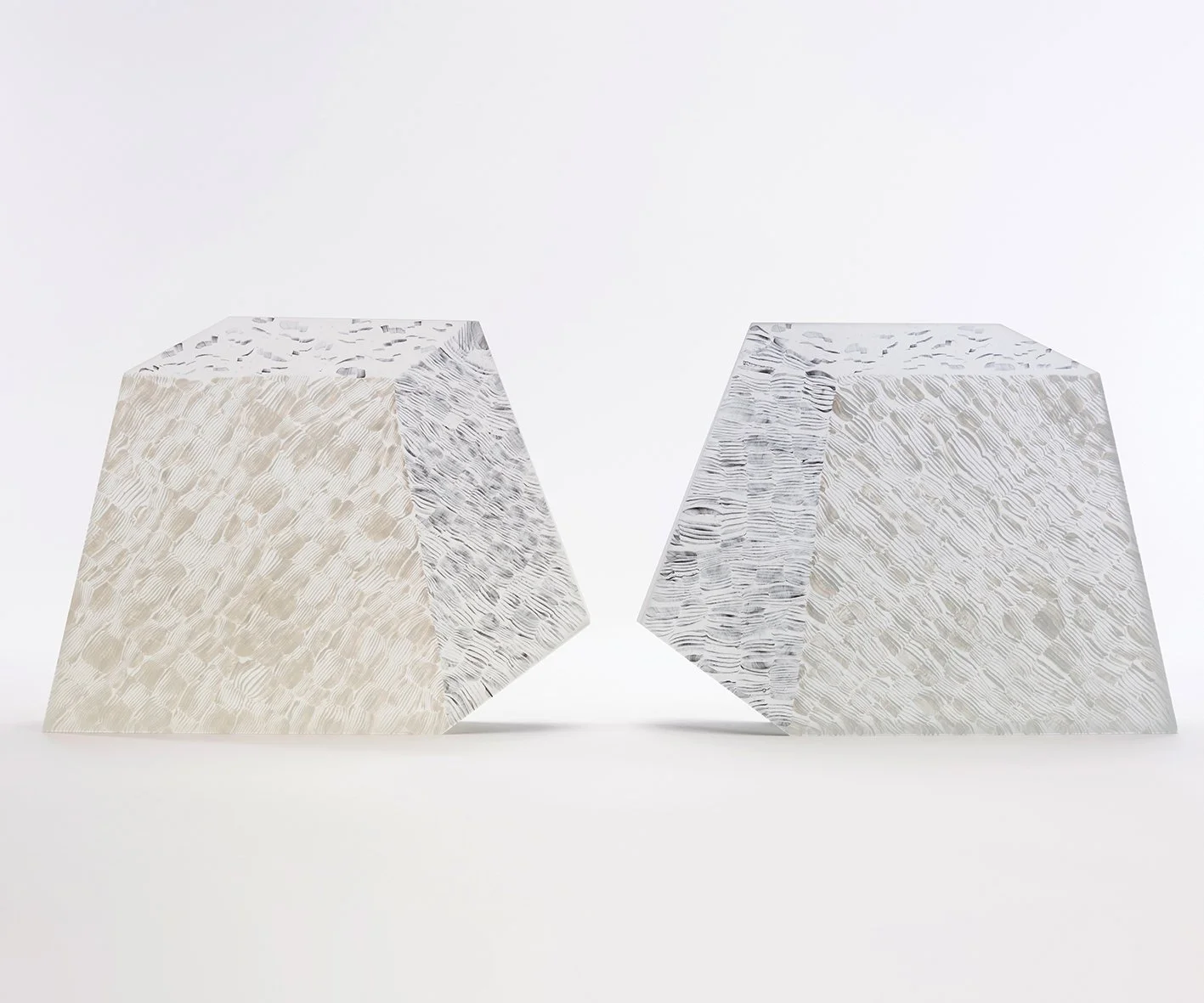
Photo: Michael Haines
Janice Vitkovsky (SA)
Surface form reflection, 2025
Fused, carved and hand finished glass
840 x 50 x 320mm
Surface form reflection is part of a body of work exploring ideas of perception and variation.
I am continually fascinated by representation and how we perceive and interpret image, surface and appearance. In an image-saturated culture, I'm interested in how things appear and with a deeper reading, what they might communicate.
Working with patterns created by the historic Venetian murrine technique, I experiment with drawing a flat image on the surface of a solid form. By illustrating an illusion of form, I investigate notions of surface and depth ultimately drawing attention to dialogue. The works invite comparison between the objects, while revealing fragility, complexity and the beauty of building meaning.
Janice Vitkovsky is an artist based in Adelaide/Tarndanya where she maintains a studio in the CBD. With a practice spanning over 25 years Vitkovsky’s work seeks to convey the immersive nature to our subjective experiences through glass.
Vitkovsky began her glass studies at the University of South Australia, from which she graduated in 1999. She then went on to complete the Associate Program at JamFactory’s Glass Studio. In addition to completing an Honours degree from the Australian National University Glass Workshop, her work combines knowledge in hot glass processes, kiln forming and cold finishing techniques, exploring ideas referencing perception, impermanence and variation. Vitkovsky’s fascination with pattern was nurtured during a mentorship with artist Giles Bettison in New York where she gained gained extensive experience in the Venetian technique of murine.
Janice maintains a studio practice in the Adelaide CBD. She has exhibited in numerous national and international exhibitions, participated in artist residency programs, and her work is held in public and private collections in Australia, Asia, Europe and the USA.