
Exhibition Insight... Making Old New: DRG 10th Anniversary
This year, David Roche Gallery celebrates 10 years of opening Fermoy House and David Roche’s remarkable fine and decorative arts collection to audiences nationally and internationally. To mark this milestone, we are proud to present ‘Making Old New: DRG 10th Anniversary’.
This exhibition brings together works of art from DRG’s 18th to early 20th-century European and British collection with contemporary responses by 20 South Australian artists associated with the JamFactory. Featuring both established figures and more recent alumni, each artist has selected a piece from the collection as inspiration to create something entirely new. ‘Making Old New: DRG 10th Anniversary’ celebrates Adelaide’s vital role in shaping craft and design in Australia, and the enduring legacy of David Roche–whose passion for exceptional design and craftsmanship continues to inspire future generations.
Photos by Connor Patterson
Words courtesy of David Roche Gallery
Established Artists

Jeff Mincham
Presented with a staggering array of choices in the David Roche collection, I initially found it difficult to connect with any single work.
Eventually I came upon the bronze statue of Sisyphus, quietly positioned aside from the main collections; a fine, elegant statue, characteristic of the times in which it was produced, with Sisyphus portrayed as a handsome, athletic young man. The story of course is harrowing – a cautionary tale about daring to defy the gods and the punishment for doing so!
However, it also represents those issues that confront all of us in our daily lives: the struggle to get that rock up to the top of the hill, only to see it roll back down again day after day, resonates with all who set out to achieve ambitious goals, or even some quite ordinary ones.
In this work I have attempted to give Sisyphus a contemporary flavour, with a more rugged interpretation of his plight, which perhaps is one we all experience at some time, in some way. He is, of course, condemned to eternity!
JamFactory: My relationship with the JamFactory began on 22 January 1976, when I began work as a full-time potter in the Ceramic studios on Payneham Road. I held my first solo exhibition there in October 1976.
In 1979 I was employed to set up and run the Ceramics Training Workshop, which I did over four years. Since then, I have had myriad involvements with the organisation, including many exhibitions and other events.
In 2023 I was recognised as a JamFactory Lifetime Honouree.

Honor Freeman
My first encounter with David Roche’s collection was overwhelming: the sheer volume of objects, the ornamentation, craftsmanship, abundance and opulence are quite something to behold. On subsequent visits, as my senses adjusted, I kept returning to the quietness of a small bronze cast of a fallen, dead sparrow on a bed of marble, located in a cabinet amongst gilded sculptures of birds. The tenderness with which it had been remembered and rendered imparted a quiet power and its presence remained with me.
As the algal bloom in South Australia stretched on over the weeks and months, suffocating ocean-dwelling creatures and plants, the despair and sadness I experienced was at times intense. As an ocean swimmer in Ramindjeri/Ngarrindgeri waters, I was witnessing this devastation on an almost daily basis; the visible suffering the creatures were enduring was laid bare on our shores. Daily apocalyptic scenes of magical and mystical once-living things, never before or rarely encountered from the wondrous depths of the ocean, washed up dead on the beach – harbingers of things to come if we don’t heed the warnings.
The ornate cowfish (Aracana ornata), a species of marine ray-finned fish, is endemic to the seas of southern Australia and is found at depths down to fifteen metres in seagrass beds in sheltered bays. For Sea-sick / Sick-sea, a mould was taken from a dead specimen of an ornate cowfish, which had washed up on the shores in November 2025 (still rich with colour), and cast in porcelain; the liquid slip turning solid and becoming a memory of a past life form – a ghost object.
JamFactory: I’ve been involved in various exhibitions (group and solo) across all JamFactory spaces over the years. Associate (Ceramics Studio) 2002–03 Tenant (Ceramics Studio) 2003–04.
Gray Hawke
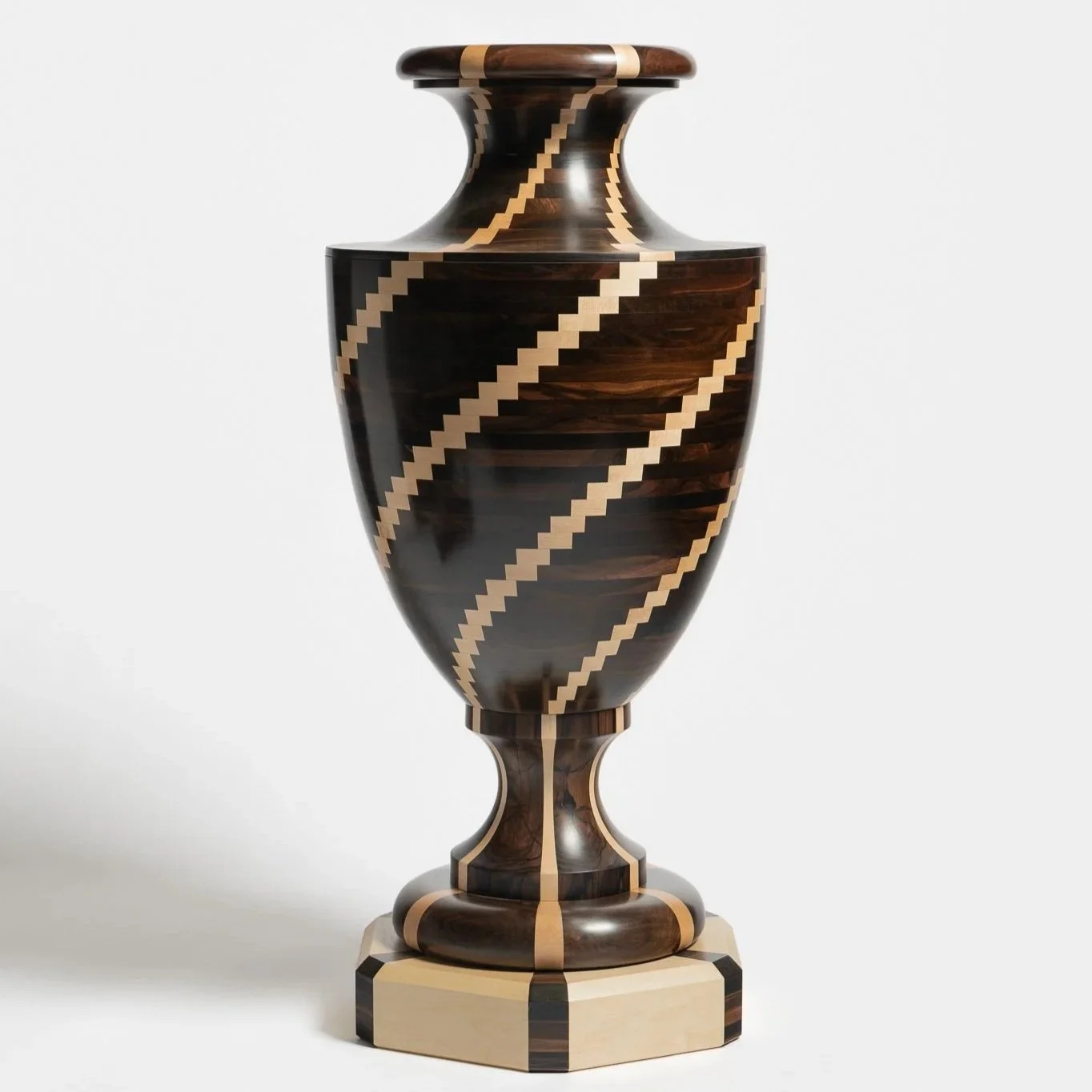
Malachite: eye candy conjured from fields of glorious green moss, solidified and morphed into earth history and mystery. Form: the language of geometry, symmetry and proportion, then yielding to random chance. History: a story, an interpretation, a social construct. These are the elements which drew me to the malachite urn in the David Roche collection at David Roche Gallery.
For me, it has been a lifelong journey. The search for truth has brought me closer to my own version of beauty and meaning – the integrity and integration of the impeccable objects and forms found extensively in nature and reinterpreted throughout human culture.
For David Roche Gallery, I have embraced both the form and the exquisite materiality of this object from the collection, interpreting and scaling it through equally considered and precious timbers.
JamFactory: My thirty-year association with the JamFactory has evolved from an exploration of design through to the mentoring of emerging designer–makers. The rich network of creativity fostered through its people and exhibitions remains integral to my craft practice.
Sue Lorraine
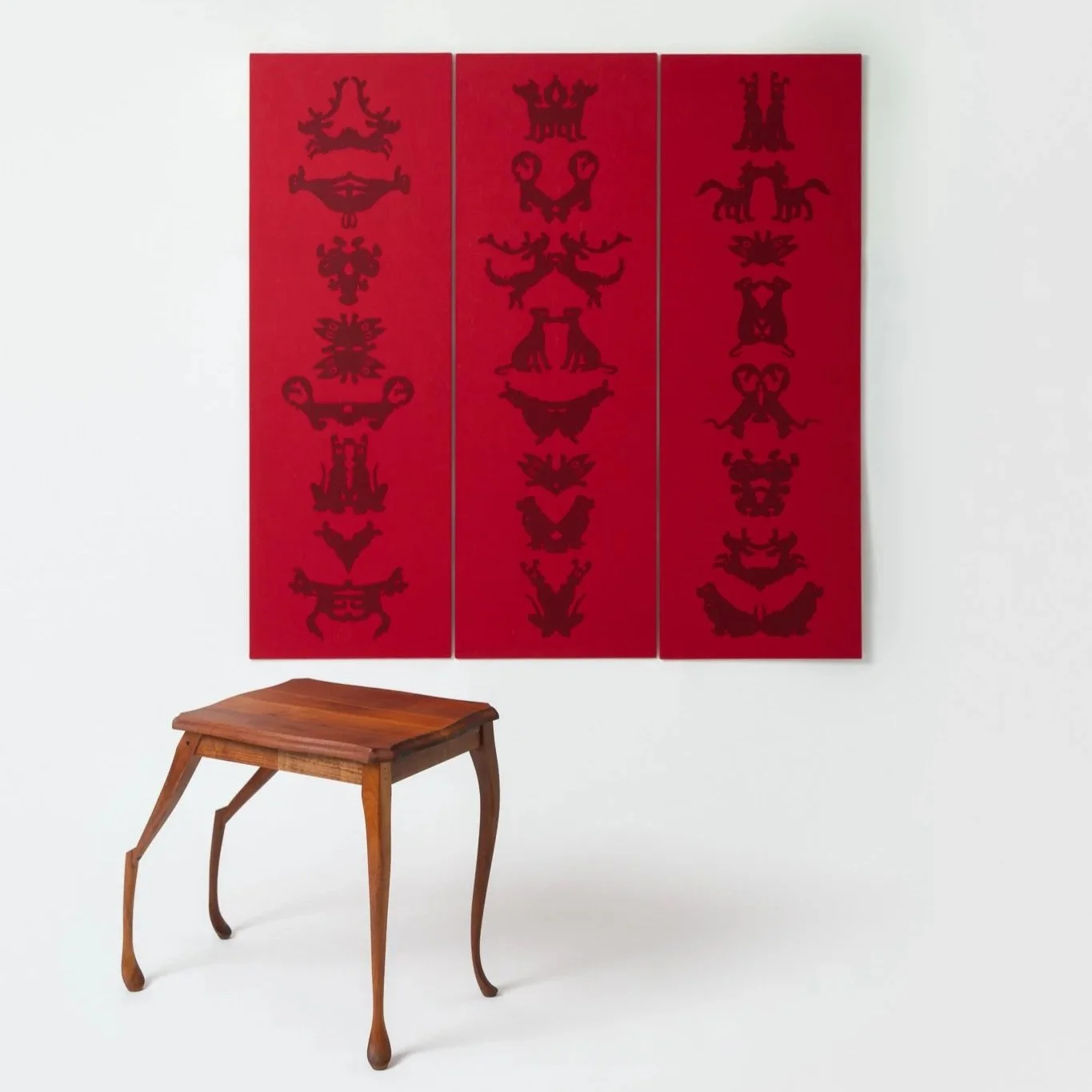
When asked to respond to a work in David Roche Gallery, I settled on the rather unsettling eighteenth-century portrait of a Havanese dog. Attributed to Jean-Jacques Bachelier, it flaunts a Lowchen lion cut hairdo.
Of all the pieces in Fermoy House, this quiet oil painting, hanging above the door in the main bedroom, was for me the most disquieting work.
The dog in the painting is all dolled up with a benign expression on her face, which is no doubt at odds with the reality of her life as a breeding bitch. This juxtaposition of the perfunctory with the coiffured made me think about our complex and contradictory relationship with domestic dogs – as both a commercial commodity and a friend – and the all-too-pervasive gender stereotypes (even in the dog world) that prevail today.
The purebred pedigree always comes at a cost in the ardent quest for perfection, a cost we are seemingly happy to accept.
I hope that the two works in my Pet Project installation, Scarlett the occasional table and the Pedigree mongrel triptych, nudge a little uncertainty your way and that you will reflect on the complicated relationship we have with domestic dogs the next time you are sitting on the couch with your ‘fur baby’.
JamFactory: I was the Creative Director of the Metal Design Studio at JamFactory from 1999 to 2008.
Between 1992 and 1994, Gray Street Workshop, of which I am a member, also had studio space within JamFactory at its Morphett Street site.

Tom Moore
Touring through David Roche’s vast collection of treasures, improbably crammed into a domestic setting, I was overwhelmed by the densely packed ceramic menagerie that populates the massive bookcase in the Green Den. My immediate thought was to reconfigure elements of the animal ornaments to construct a stacked arrangement: a bird on a cat on a dog on a donkey, based upon an unlikely fellowship in an old folktale. The Musicians of Bremen is a mad story and feels as if it was thrown together as a flimsy rationalisation for the magnificent moment when the animals unite. The disparate band of dejected domesticated beasts pile up into an indomitable icon of natural order and triumph over the human villains. This revelation of precariously balanced abundance renders me giddy.
The spotty pony that I chose to reinterpret as the base is totally bonkers. I particularly enjoyed adding the riderless boots as a nod to the departed military bloke.
Having completed the stack, I began to focus on the profusion of amusing Staffordshire small hounds, unevenly rendered and arranged in eccentric symmetrical groupings. The coloured underglaze painting is at times apparently dashed off in a haphazard manner, imbuing the creatures with a charmingly bemused character.
I was thinking about the importance of dogs in David’s own life: the time and care dedicated to becoming Australia’s most awarded dog exhibitor; the countless litters of puppies born in the backyard kennels (now replaced by the gallery); and the daily comings and goings of negotiating with so many canines. I added some references that are central to my own dog story: tennis balls, feeding and resulting bodily functions.
I am fascinated by the ways in which nature is observed and represented and, consequently, by how the animals are house-trained and humanised in David’s Green Den.
JamFactory: I was a trainee at JamFactory in 1995–96, production manager 1999–2015, and a regular studio hirer from 2016 to the present. I was recognised as a JamFactory ICON with a major exhibition and book in 2020. Currently I mentor the 2026 glass associates.
Clare Belfrage
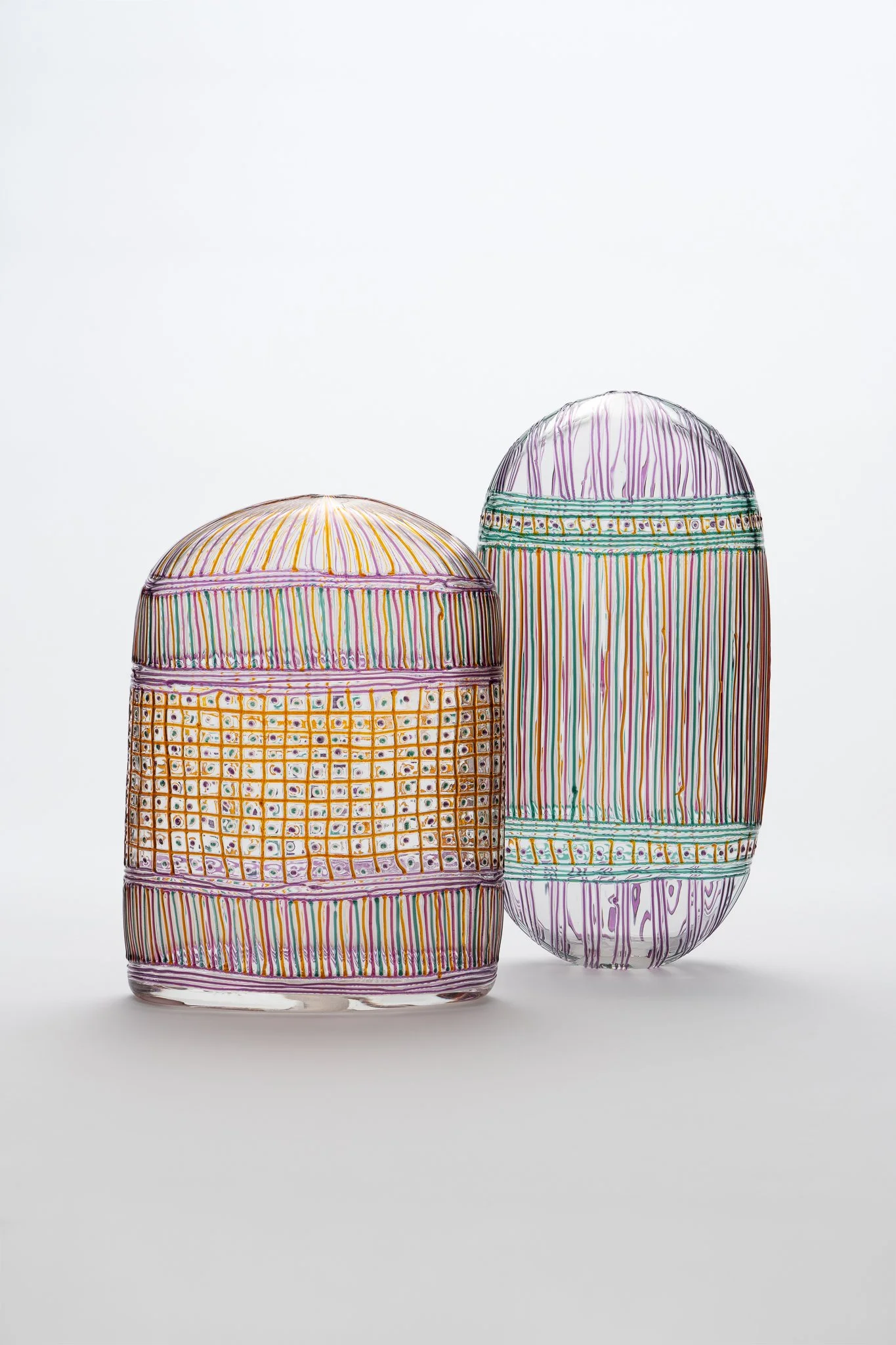
Registering, contemplating and creating pattern is clearly a profound human instinct. It is something I have worked with for many years, particularly the rhythms and patterns experienced in the natural world, both real and imagined.
The straw boxes in the David Roche collection that have inspired my works in the exhibition are exquisite. The patterns and their relationship to the forms are exceptionally pleasing, as is the feeling of preciousness created with this basic material – straw. It is made to appear gold-like and when dyed, rich and jewel-like. The scale is intricate and delicate, an expression of fine skill, a sharp eye and patience.
They make me think about time. The boxes are believed to have been made by prisoners of war and I wonder, for these makers, was time a friend or an enemy? I know that when I work with repetition, using a recurring element to build up a pattern, that action creates its own rhythm and movement through time. Time opens out to move faster and slower at once, imparting a particular sense of time being suspended.
Again, relating to the making, the intricacy of pattern asks the maker to lower their gaze, not to look outward but rather to allow this small area of straw – or, for me, glass – to fill their view. It creates a world in which to fall, providing another experience of freedom from the external world.
I have worked with elements from these boxes: aspects of the patterns, enlarged and simplified; the colours; the sense of intricacy; the forms. Using my drawing technique of heating fine threads of coloured glass, which I have prepared, and fusing them onto the surface of the blown form during the hot process, I have created these new works in glass.
JamFactory: I undertook the training program in glass in 1991–92. Since that time, even though I’ve had a few chapters out of Adelaide, I’ve always stayed connected to the glass community that is built around the JamFactory. I’ve blown glass there a lot, gone to a thousand studio clean-ups and hirers’ meetings, been in many exhibitions, including my first solo show in 1993, and was the JamFactory ICON in 2018, also presenting a solo show.

Takeshi Iue
I am a contemporary furniture designer–maker based in Adelaide. My practice pursues the timeless object, one that embodies restraint, clarity, and enduring presence. I am guided by the beauty of subtlety and the quiet irregularities of natural randomness, while remaining attentive to the mathematical proportions that underpin both natural and built environments. My work is pared back in form, often concealing complex construction within an apparently simple gesture.
The Chess Casket and Diorama, developed in collaboration with Stephen Bowers, were conceived after reflecting on the David Roche collection, with its enduring dialogue between black and gold, elegance and theatricality, order and ornament. Handcrafted in sycamore maple, each casket reveals the quiet authority of fine timber construction. The Chess Casket structure draws inspiration from the Japanese jubako – the tiered lacquer boxes traditionally used for ritual presentation. Stacked compartments separate black and white chess pieces, transforming rivalry into equilibrium. The lifting of each tier becomes a deliberate, ceremonial act, echoing the measured progression of the game.
Surfaces are enriched with hand-rendered penwork in the spirit of Regency decorative arts, bridging historical refinement and contemporary expression. The interplay of black and gold heightens the drama, while disciplined linework maintains clarity and restraint. In dialogue with Stephen’s practice, ornament is balanced with compositional control. These works are not simply containers for pieces, but vessels of time – layered with craftsmanship, symbolism and the enduring pleasure of close looking.
JamFactory: My connection began in 2006 when I joined the Associate Program in the Furniture Studio. Over the years, I have continued my relationship through participation in significant milestone exhibitions, including the JamFactory’s fortieth and fiftieth anniversary exhibitions.
More recently, I had the privilege of collaborating with the Furniture and Ceramics studios on JamFactory’s product chair, Hold Chair. This cross-disciplinary project reflects my ongoing commitment to material exploration, craftsmanship and contemporary design practice.

Nick Mount
Cane carrying was once an art form in its own right.
Carrying symbols of fashion, style, authority and pomp.
All demonstrated through fine materials and virtuoso crafting.
The history of handmade glass also includes myths that supported the knowledge that a twisted glass cane was effective in keeping evil spirits out of the worker’s home. As a privilege, the glass makers would be given time to work the glass for their own purposes. The objects, called ‘friggers’, could be decorative, functional or fanciful pieces, designed to demonstrate the maker’s skills with their hands and materials. Twisted glass canes were something that might be made to take home and protect the family.
I’m not entirely sure how common it would be for a factory worker – apart from glassmakers – to view working longer hours, in their own time at the factory, as a privilege or a special right to be earned. Perhaps this reveals something about what the materials and processes can offer to a maker through the work of their hands.
I like the collection of canes in the David Roche collection for their materials and crafting as much as for their function and elegance. Function for ramblers, strutters and crafters.
The pieces I have made are compositions of found objects. Some from my studio, some from my natural surroundings and my own ramblings.
JamFactory: My professional engagement with JamFactory Glass Studio has spanned multiple roles, including Hirer, Head of Studio, Mentor, Designer, Exhibitor, and Supplier.
Stephen Bowers
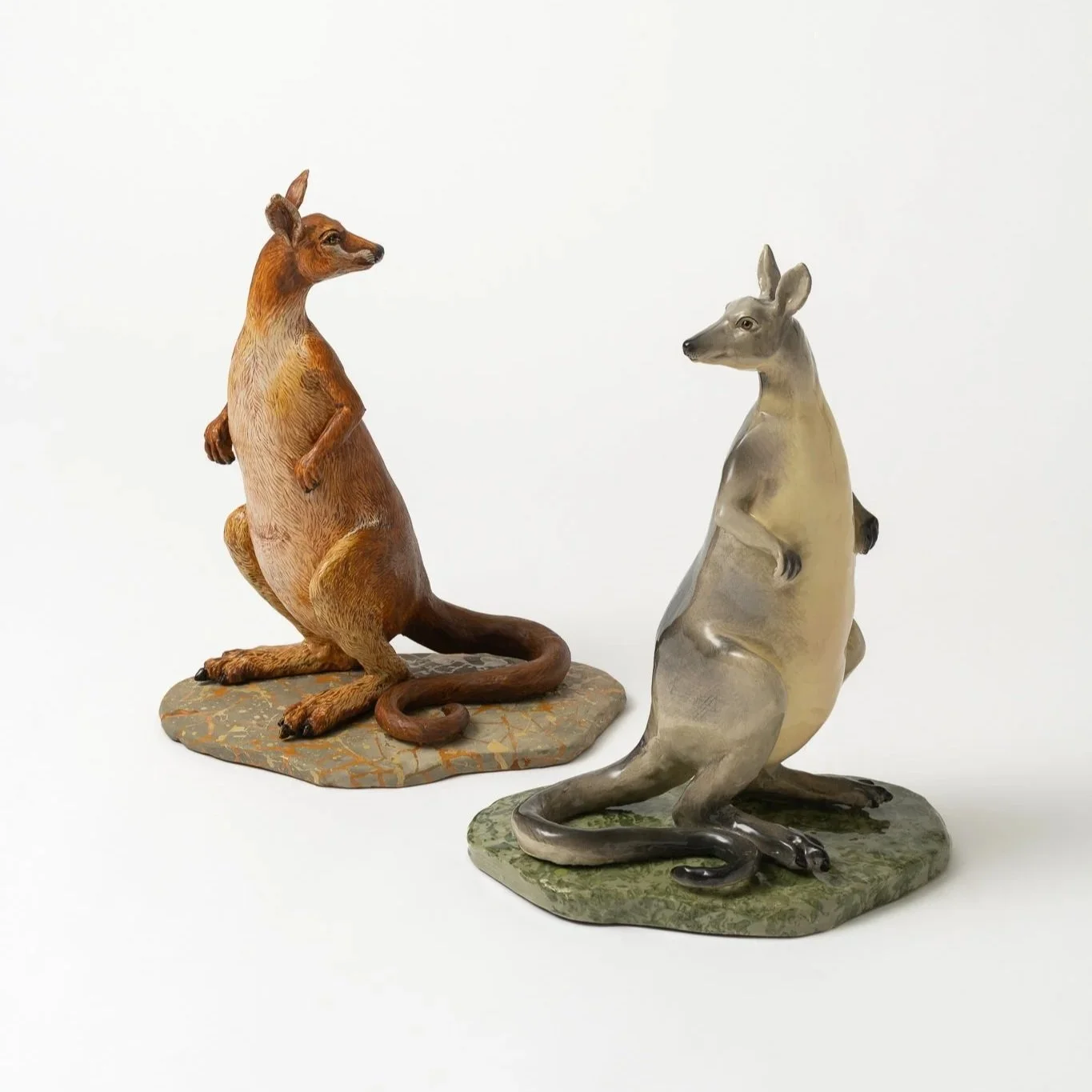
In addition to large connoisseur objects, David Roche Gallery holds a rich peripheral profusion of smaller pieces, many in the form of production wares: Meissen, Dresden and Staffordshire, among others. Often mass-produced, these works are most amusing in their inventive explorations of material and technical variety, utilising dexterous hand skills, as well as industrial processes (engine turning, slip-casting, press moulding, on-glazing, etc) in their rapid production.
Pieces like dinner services and tablewares were regular catalogue products, distributed and sold in town and city shops. Others were more marginal, like the speculative Staffordshire figures, which could be collected in no particular order and for no particular reason and which were often casually displayed in cabinets or arranged along mantel pieces as theatrical entertainment pieces. These small works went direct to country markets, sold as ‘fairings’ at rustic fairs; they were inventive ‘cheap-N-cheerful’ collectables, amusing souvenirs and quirky ornaments. Part-familial still life, pastoral tableau, satirical commentary and bucolic ornamental cliché, they are also symbols of domestic utility and interiority – reflective of the complex social and cultural histories of the time.
David Roche had a good eye for the charm and interest of these often humorous and light-hearted works and it is these informal, irregular subaltern objects that influenced my approach to this exhibition – along with the opportunity to collaborate with designer–maker Takeshi Iue and sculptor Andrew Stock.
For Takeshi’s elegant reductive take on the formalities and possibilities of a chess set storage box, I sketched in pen and Indian ink directly onto the surface and the result is a very loose ‘chinoiserie’ style of decoration. This approach can also be seen in our small ‘diorama’.
Andrew and I have worked together many times across the years and for this exhibition I used both underglaze and cold-painted techniques on his hand-modelled sculptures.
JamFactory: My association goes back to the early 1980s when I took up a traineeship in the Ceramic Studio, later becoming a tenant and renting a studio. I became Head of the Ceramics Studio in 1991, a position I held for nine years. From 2004 to 2010
I was Managing Director of JamFactory.

Kath Inglis
The colourful birds depicted on a pair of hexagon-shaped Worcester vases, located in the Military Room, caught my attention. These colours are often represented in my practice so I felt an instant connection to these creatures. My fascination grew when the gallery guide John explained that these are known as ‘fancy birds’ or ‘dishevelled birds’.
These birds were conjured by their eighteenth-century English artists and never existed in the real world. Visual references to ‘exotic’ birds from Africa, Asia and the Antipodes such as parrots, cockatoos, peacocks, birds of paradise and the dodo, are ‘Frankensteined’ together into new, wild-eyed, feathered freaks.
Well-known idioms such as ‘Dumb as a dodo’ and ‘Dead as a dodo’ came to mind while researching this subject. Before they became extinct in the late seventeenth century, dodo birds lived on the tiny island of Mauritius in the Indian Ocean. The Dutch took possession of this land in 1598 and it became an important destination for resupplying provisions to trade vessels of the Dutch East India Company. The dodo had no significant predators on the island and was entirely fearless of humans when they arrived, having absolutely no comprehension of the danger before them. This and their inability to fly made them utterly vulnerable to hunting by humans and predation by introduced animals such as rats, dogs, cats and pigs.
Many indigenous people and species of native flora and fauna do not fare well when colonisation, with all its impacts, arrives upon their shore.
In response, I have created a trio of fantasy feathers plucked from ‘dishevelled birds’. Each piece is made from hand-coloured polyvinyl chloride (PVC). Three layers of material are hand-cut, carved and heat-fused together to create an animated play of colour, light and shadow in the form of a plume.
JamFactory: In 2002–03 I worked as a Design Associate in the Metal Design Studio, returning in 2021–23 as Studio Head.
Emerging Artists
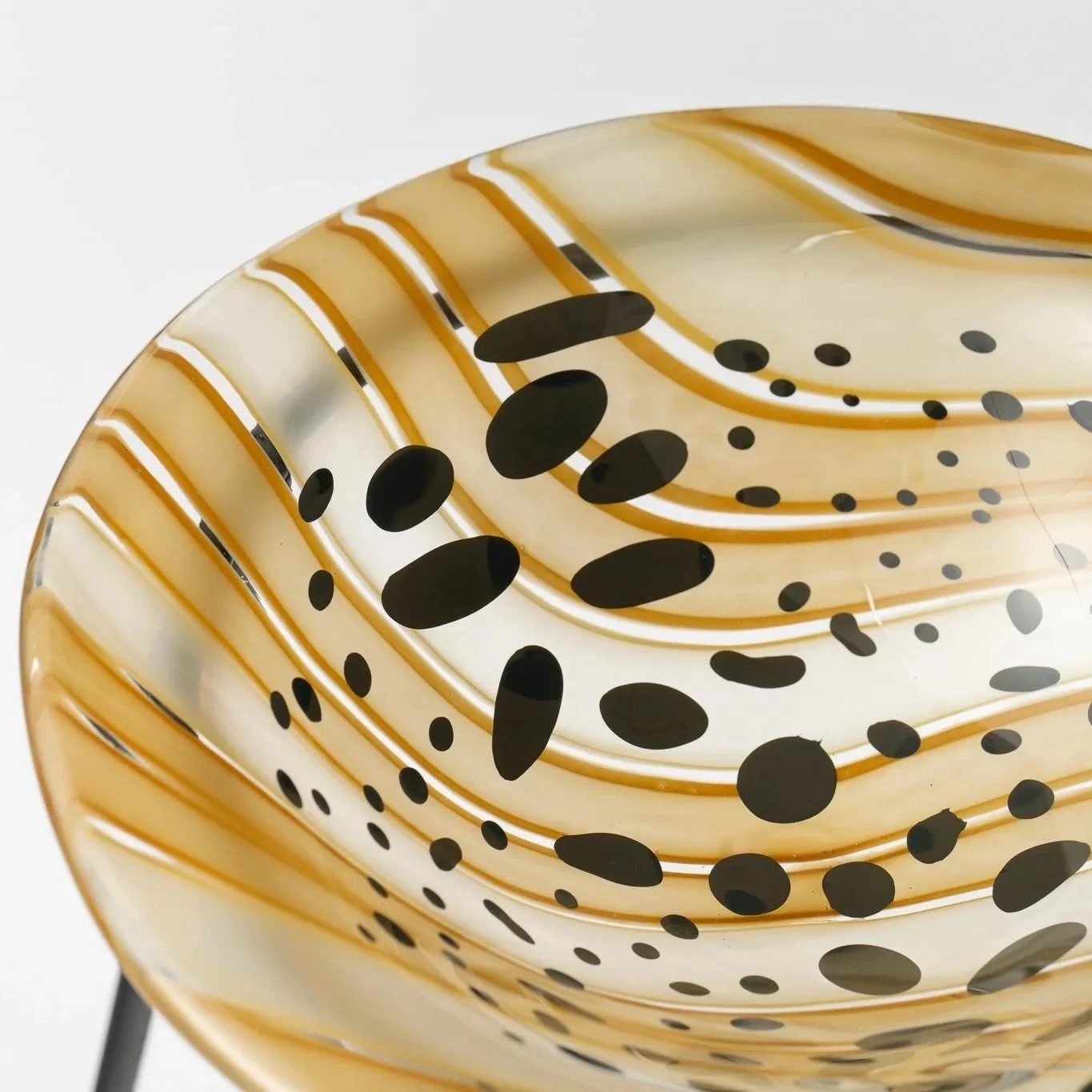
Emma Young
The Drawing Room in David Roche’s Fermoy House took my breath away. The opulence, combined with fun colours and thoughtful handmade choices in that room, makes it feel alive with activity. I was drawn to the pair of metal standing bowls either side of the secretaire, tickled by their core functionality among over-the-top decoration. When I was learning more about these pieces, it simply came down to the fact that they’re bowls for keys. ‘Vide poche’ is French for ‘empty pocket’, so this is a place to stash your things when you walk in the door after a day at work. Most can connect with this experience; I myself have a handmade keys bowl in my home’s hallway, albeit not gold-clad with long legs and ram’s hooves.
Glass blowers often make common functional objects: bowls, tumblers, bottles, but with a decorative personal spin to instil a uniqueness and higher value to the handmade pieces. I saw an opportunity to create my own ‘vide poche’ in a way only a glass blower could conceive.
Elsewhere in Fermoy House, I felt captivated by the leopard and cheetah fur prints adorning much of the furniture: David’s bed, chaise lounge, couch, seats and armchairs. Learning this upholstery was not real animal skin but French silk reproductions impressed me, and I wondered how I might echo those structured brown and black animal patterns in glass. I experimented with techniques and colour applications to achieve the cheetah print I envisioned. The resulting bowls use a veil cane plunger pick-up stuffed cup with stringer spots drawn onto the bubble beneath. There were many stages to this process but a gratifying result was achieved. The complementary metal stands are handmade in South Australia.
JamFactory: I undertook the JamFactory glass training program in 2016–17 and was a studio tenant there in 2018–19. I continue to hire JamFactory’s glass-blowing facilities weekly to create my own artwork and production lines.

Lotte Schwerdtfeger
These three nerikomi urns in white and terracotta earthenware respond to a Blue John handleless krater – a vessel carved of rare, banded fluorite. The work engages a long tradition of using ceramics to imitate precious and semi-precious stone. Examples can be traced back as far as Bronze Age pottery, in which spiral and banded surface patterns became stylised conventions, through to Ancient Egyptian painted finishes, to eighteenth-century agateware traditions.
Initial tests, using polychrome low-fire glazes to replicate the tonal complexity of Blue John, proved unsatisfactory; they lacked the material honesty with either the source stone or the ceramic medium. The style of the work was redirected toward nerikomi and agateware techniques, using recycled white and terracotta clay. Layered blocks were built up through repeated slicing, folding and compression. Slabs were cut and inlaid to form the urns. The surfaces were then turned and sanded back, to expose the interior marbling. The process is subtractive and lapidary in character, revealing pattern through removal of surface rather than application.
The resulting works do not attempt to reproduce the materiality of the Blue John urn. Instead, they are an aesthetic inversion, adopting its vessel form while foregrounding the properties of clay itself; they propose that the craft of transformation, the patience of the hand, and the honesty of modest materials carry their own form of richness.
JamFactory: I was a JamFactory associate in the ceramics studio from 2023–24 and then continued as a tenant in 2025. I now lead tours of JamFactory and sell my works in the shop.

Alex Hirst
On reviewing the David Roche collection, I was immediately drawn to the Victorian children’s rattles, their delicate intricacy, scale, ornate metalwork and the care and craft embedded in something made for a child’s hand. Beyond their beauty lies a more complicated history: these rattles were luxury items, gifted among the wealthiest families to be placed in children’s hands when having their portraits painted – a symbol of status as much as tenderness.
What drew David Roche to acquire such objects? Was it their craftsmanship, their history, or the quiet poetry of an item designed to soothe? David never had children himself and I find that detail quietly resonant.
My response reimagines the rattle in hand-blown glass, hand-etched with delicate patterns and a wrapped-kangaroo leather handle. The material shift from metal to glass introduces fragility. It grants the object a certain vulnerability instead of permanence.
While making this work, I grapple with the uncertainty of whether to have children of my own. Approaching my mid-thirties and recently married, I find myself facing a question shared by many of my friends and peers. The rattle becomes a vessel for that tension: desire and hesitation, legacy and doubt, protection and risk. It speaks to care, to inheritance, and to the fragile weight of possibility we hold in our hands.
JamFactory: I was an Associate at the JamFactory from 2020 to 2022. I now hire the glass studio facilities to produce my own work and continue to work on production teams within the JamFactory.

Michael Carney
The Moinet à cercles Tournants mantel clock first struck me through both its elegant silhouette and the unusual functionality of its two rotating circles, which serve as the clock face. I additionally became interested in how the object’s role as a timepiece is echoed across its decorative features. Figures appear to gossip across the upper section where handles might typically reside, while the ‘Dancing Hours’ relief depicts the Horae, the Greek mythological figures who personify the seasons and the passage of time.
In my response, I sought to engage this temporal theme through a more sombre and ominous register. A sense of decay and erosion in the sculptural surface speaks to a contemporary, more combative, relationship with the passage of time. The work began with the mantel clock’s silhouette as a point of departure, after which the form was developed through simultaneous acts of construction and deconstruction. Decorative flourishes are deliberately unsettled by aggressive cutting and scooping into the vessel’s body.
Echoing the clock’s additional layer of functionality, I incorporated a light element to introduce a note of pragmatism into the decadence, while also heightening the theatrical drama of the brown, pink and black palette. The vase was formed using wet slips and dripping clay, processes that were frozen permanently in the kiln. In this way, the surface itself performs time held in suspension, flux captured within a static object.
JamFactory: I was a Ceramics Associate at the JamFactory from 2019 to 2020 and a studio tenant in 2021. I now operate from my own studio in Kent Town, South Australia.
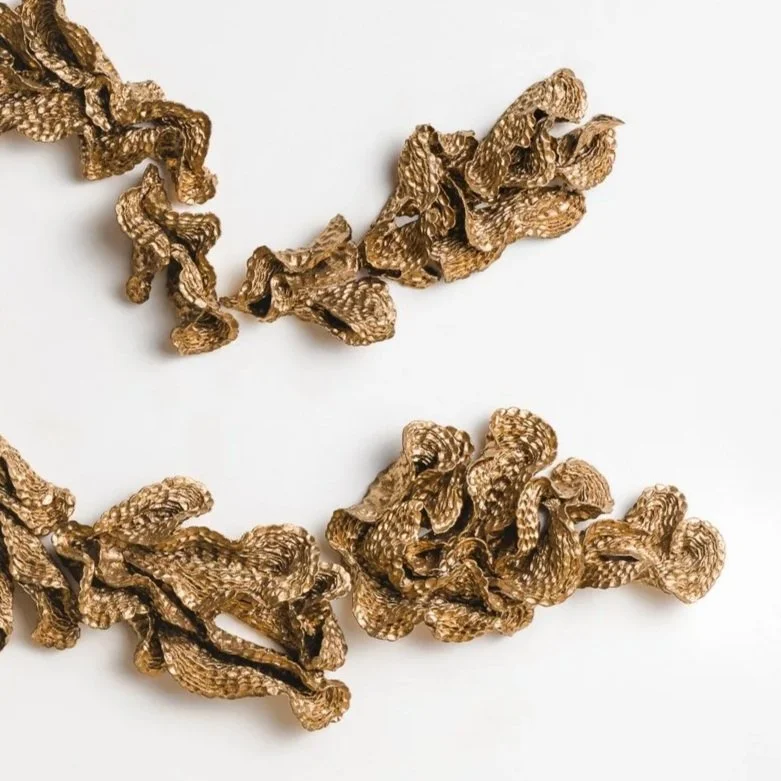
Sam Gold
A small bronze sculpture of a pheasant with finches is the work I selected to make my response to the David Roche collection. I chose this work because its essence of movement in the sculpture stood out to me. The bronze work captures a moment between the three birds, yet what held my attention most was the rhythm of its construction, the repetition of feathers – reminding me of wingspans – and the delicate tension between protection and being grounded after or pre-flight.
Rather than replicate the narrative of the bronze sculpture, I became interested in the choreography embedded within the form itself. The structure of wing against wing, feather against feather, suggested a language of repetition that echoes throughout the natural world and finds parallels in the layering of mineral surfaces, the formation of mineral bodies, the quiet accumulation of small gestures, which together hold a larger structure aloft.
My work responds by slowing this movement down. The sculptural form I have produced sits within the suspended moment between lift and rest, where pattern becomes visible. Repeated elements extend outward, reflecting the span of wings while also evoking the material processes that underpin much of my practice – growth, accumulation and subtle transformation.
In this way, the work moves away from representation towards an embodied echo of the original sculpture. The gesture of the bird becomes a field of repeating forms, allowing attention to settle on rhythm, weight and the fragile architecture that enables bodies to rise.
Through this response I am interested in how observation becomes translation: how a moment of care, movement and structure can be reimagined through material language.
Jamfactory: I was first engaged as an Associate at the JamFactory in 2020 and continued my relationship as a studio tenant in 2022 and 2023, working independently while remaining part of the JamFactory studio community. My work has been presented through JamFactory’s exhibition and professional networks, contributing to contemporary craft and material practice in Australia.

Polly Dymond
My relationship with waste verges on phobic. Images of overflowing landfill and fish with bellies full of microplastics keep me up at night, the biggest culprit being disposable and single-use plastics. The pattern of relentless industrialisation and mass production has led us to a collective endemic of thoughtless reliance on plastics and an environmental catastrophe.
Utilising street-salvaged discarded polystyrene and single-use plastics, combined with ancient metalsmithing techniques and found objects, I seek to reimagine and elevate these dangerous and overlooked materials. I aim to prompt reflection on consumption patterns, perceptions of value and material lifecycles and to interrogate economic interest at the expense of our planet’s sustainable future.
My aim in responding to The ‘Kedleston’ Vase is to echo its theatrical excess and rebelliousness, along with the overwhelming opulence of the piece, while keeping true to my ethos of reconsidering waste and value. The work is constructed from waste polystyrene, toy rubber snakes and found ceramics, with each material equal to the other, none more valuable or important. In lieu of decorative figurative painting, polystyrene ‘beads’ are delicately and laboriously affixed to the base object, contrasting with, but also celebrating, the fine craftsmanship of the original.
Through the alchemic process of electroforming, I entomb and fuse all elements beneath layers of hard copper armour; transformed into something delicate yet loud, recognisable yet foreign, once discarded now precious. The resulting work celebrates a maximalist aesthetic, in contrast to the bland, inoffensive and inexpensive mass-produced objects that proliferate across the world (and landfill) today.
JamFactory: Associate in the Jewellery and Metal Studio, JamFactory;
Studio tenant 2020–22

Andrew Carvolth
This work, Distillation, was developed in response to three objects in the David Roche collection. From a collection largely defined by grandeur, ornament and historical decorative arts, my attention was drawn instead to three modest utilitarian objects: a steel pan, an iron can opener and a copper mirror. Each is formed from a single material and each carries a directness shaped by utility, material constraint and making.
Set against the richness of the surrounding collection, these objects possess a quiet authority. Their forms are not decorative in a conventional sense, yet they contain distinctive gestures. The elongated handle and shallow bowl of the pan, the small zoomorphic silhouette of the can opener, and the rhythmic domed perimeter of the copper mirror each hold an inherent sculptural clarity. Their character emerges through function, use and the material logic of their construction.
In response, I developed a wall mirror in timber with applied carved elements. The forms are distilled from the gestures present in the three objects. Rather than reproducing them directly, I have abstracted these shapes and recomposed them so that their essential qualities migrate into a new object.
The mirror becomes both a reflective surface and a site of translation.
The applied forms echo the language of the original objects while shifting them into a contemporary sculptural context. Through this process, the work acknowledges the intelligence embedded within humble tools and the cultural traces of craft, folk traditions and everyday use carried within their forms.
JamFactory: I relocated to Adelaide after being accepted into JamFactory’s Associate Program (2017–18) and have since remained closely connected to the organisation as an Associate, Production Manager, Studio Head and Short Course Tutor, as well as exhibiting through its exhibition program.

Jordan Gower
Nocturne in Black takes shape in the form of six stoneware vessels, glazed with a dark, iron and manganese-rich surface and fired multiple times in an electric kiln.
My original interest in the secretaire abattant came from the striking contrast between the black and gold lacquer panel, as well as from a vague sense of nostalgia from the chinoiserie motifs. This is an object that was enjoyed for its beauty, not necessarily its function, as letter-writing had fallen out of fashion by the time it was acquired. Although the original piece is French in manufacture, I started my response by looking back to historical Chinese glaze chemistry, finding entryways into the lacquer panel, which made sense within my discipline.
What continued to stand out for me was how the front panel, with its lyrical, slender botanical motifs, is framed by sturdy kingwood construction and a weighty marble top, all raised up by dainty feet. This is an object that has a steadfast verticality and presence, but draws you into an inky, sultry world. I wanted to reflect this harmony of curves and lines in my grouping of ceramics.
Ultimately, the work took shape after thinking back on the negative space of the lacquer panel, finding a rhythm between five grounded vessels surrounding a single floating profile – a small gesture towards an impressive object.
JamFactory: Since October 2023 I have been the Head of Studio at JamFactory Ceramics.
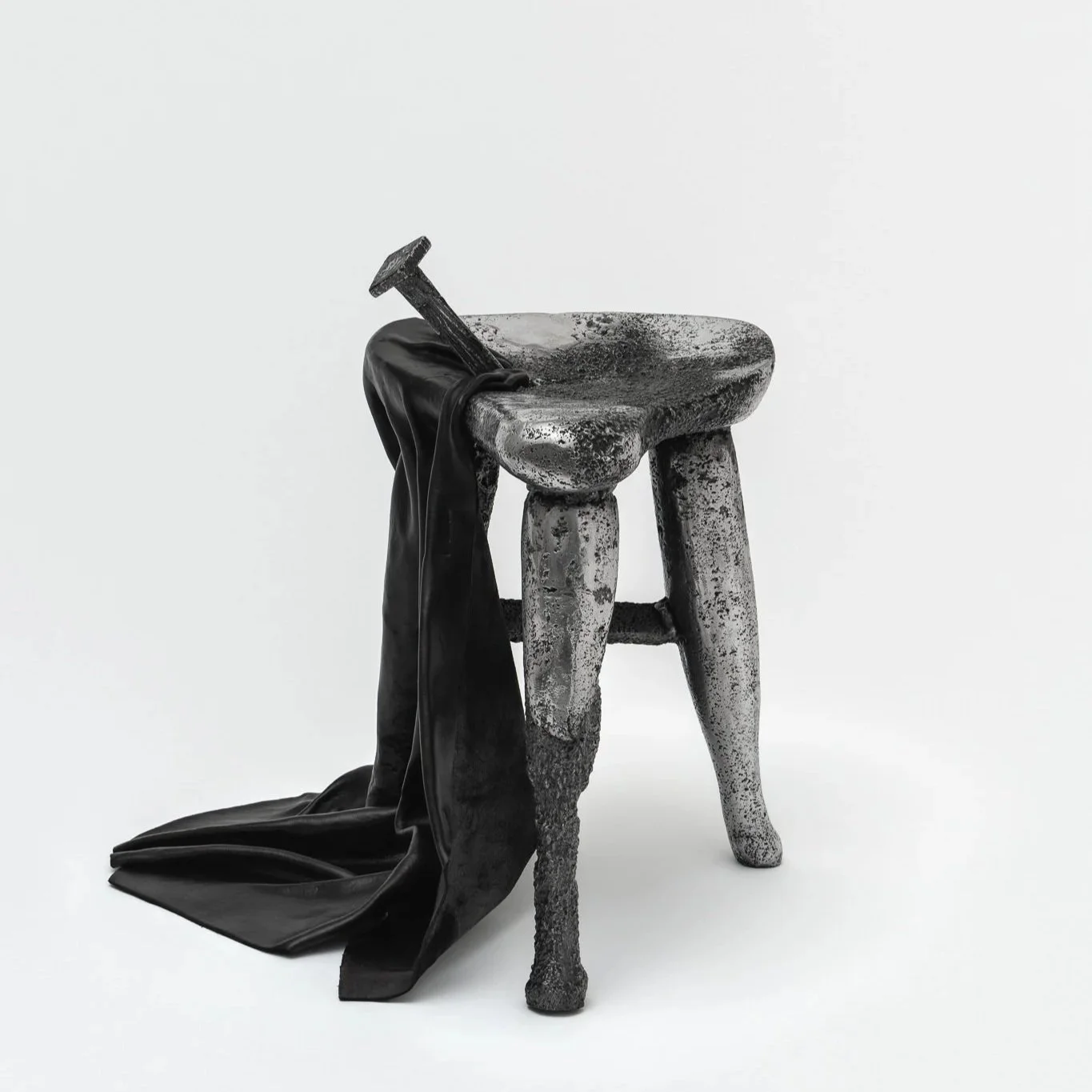
Saturday Yard Work / Nathan Martin
Not a gambling stool? Though the name may suggest otherwise, there is little association between the carved timber stool and cockfighting. Rather, the circumstances of where this stool has been located throughout history have given it a narrative far from its intended use, and by placing it at these events it has gained an identity far removed from the original. The introduction of this piece only by its somewhat congruous name leads to ambiguity in its intent and assumptions can only be made from its form. Consumers and collectors hold the ability to redirect the narrative of an object or breathe new life and meaning into it. What is known as a stool associated with an abhorrent type of gambling can contrastingly be used for much more remedial tasks. It’s not to say objects can’t have multiple uses throughout their lifetime but for one to have such a stark difference while maintaining its title is nevertheless humorous, yet questions intervention.
This stool is for polishing, not gambling delves into the themes of disassociation and ambiguity, with a piece that somewhat reflects the form of the cockfighting stool, showing glimpses of how it may look in its true form. Its decayed form, paired with the polished surface, resembles and gives a nod to its new narrative, life and associated use.
JamFactory: Saturday Yard Work / Nathan Martin is a recent alumni of the JamFactory Associate Program, from the Furniture Studio from 2024 to 2025.

Nat Penney
worth your weight/worth the wait
worth your wait (is it?)
is it worth the wait, thinking about the pecking order
worth your weight being dragged around
to order what you do, hoping for chance to take hold
does it feel like you’ve struck gold if you do, do we see through it all as soon as we put the
emperor suit on
or
do you just keep stacking, keep calculating, keep swinging and a miss
should you put it away, shut the lid, just click and swing all the pieces back and forth (they’re not going anywhere) and feed yours instead.
I started with an imperial peck made in 1838, filled with corn kernels, not popped yet. A historical measuring vessel for dry goods. A container for labour, for value, for what something weighs or amounts to.
Peck. A measure.
Imperial. Also, a measure. An order. The pecking order stacks us all on one another. Just chickens scrounging for corn.
Measuring, stacking, calculating. Thinking about worth.
Worth your weight.
Worth the wait.
I made three objects: an abacus, a valet chair with tennis racquet heads as pivoting hoops, and a simple framework.
The abacus of popped corn counts and recounts. Sliding beads back and forth. Small calculations, just the satisfying click of a tiny handful of weighted objects, holding importance.
The chair holds the body after effort, with everything from the day shut tight in the trunk below. Tennis racquet heads with no strings forming the back – hoops, swings, repetition. A place to pour out everything you needed. A place to put the day away beneath the hoops. instead of jumping through them.
The frame holds plants in the house. Something to hang from. Something that supports slow growth.
A chair, an abacus, a framework. Three small structures circling measurement, labour, pouring out.
JamFactory: At George Street Studios from 2021 I was fabricating JamFactory’s steel ‘sit’ range and in 2023–24 I was an Associate in the Furniture Department. Currently a director of fab workshop, I continue to maintain a working relationship with the staff and associates of JamFactory (present and alumni).